
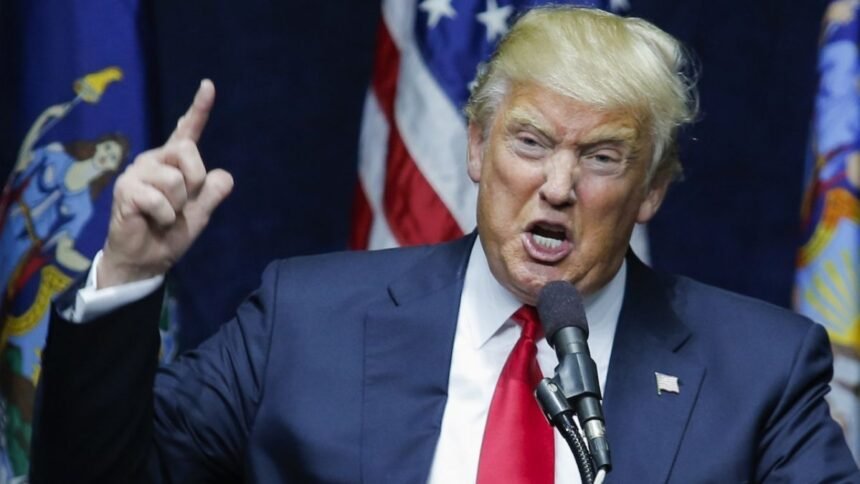
President Donald Trump warns Washington that he won’t forgive disloyalty, and even if it wasn’t a literal quote, the message of his latest outburst can be summed up as: “I will burn anyone who opposes me.” With his approval ratings sliding and renewed accusations that his White House is trying to bury the Epstein files, Trump heads into Tuesday night’s State of the Union needing a win—and looking for villains in the front row.
The target this time is not a cable-news foil or a Democratic leader. It’s the U.S. Supreme Court—the same institution Trump once treated like a crown jewel of his first term.
A Court in the crosshairs
On Friday, Trump erupted after a 6–3 Supreme Court ruling that wiped out the legal foundation for his sweeping emergency tariffs—tariffs he has argued are central to his trade agenda, his foreign policy leverage, and even his national security posture. The decision, as reported, held that the tariffs exceeded the law Trump relied on.

Trump didn’t just criticize the decision. He went personal—especially with two justices he himself appointed: Neil Gorsuch and Amy Coney Barrett. In the harshest phrasing reported, Trump called them “fools” and “lapdogs,” and said the ruling was “an embarrassment” to their families.

Trump also seemed to aim at Chief Justice John Roberts, the Republican appointee who, according to reporting, wrote the opinion that dismantled Trump’s tariff scheme.
What makes this moment different is timing. On Tuesday, the justices will sit in the House chamber during the State of the Union—normally noticed only in passing. Now, their silent presence becomes part of the story, a visual reminder that Trump’s power has limits—even with a conservative majority on the bench.
Loyalty as a litmus test
Trump’s worldview is simple enough for a 10-year-old to understand: if you help him, you’re “great”; if you block him, you’re “disloyal.” That is not how courts are supposed to work.
The Supreme Court is not meant to act like a party committee. Justices are supposed to decide whether a president followed the Constitution and the laws Congress passed. That idea can feel abstract—until a president tries to do what Congress did not clearly authorize, like using emergency powers to impose broad tariffs that reshape prices, supply chains, and business costs across the economy.
Trump’s anger also shows how he misunderstands the justices he didn’t appoint. He claimed the Democratic-appointed justices are automatic “no” votes. But Democrats themselves were furious last year when Justices Sonia Sotomayor and Elena Kagan were in the mix of a Supreme Court ruling that cleared the way for Trump to resume major federal layoffs and restructuring. The practical result was fear and chaos among federal workers—and a reminder that ideology does not always map neatly onto outcomes.
For readers who want the primary source, the Supreme Court posted the case paperwork and opinions online.
The SOTU pressure test
Trump did find one justice to celebrate: Brett Kavanaugh, another Trump appointee, who sided with him. Trump reportedly called him a “hero.”
But the broader pattern is bigger than one tariff case. When allies stop being useful, Trump tends to turn on them fast. Marjorie Taylor Greene, once a rising MAGA star, became a target after pushing hard for the release of the Epstein files, according to reporting.
Even Elon Musk—once a prized political accessory in Trump’s orbit—has faced threats after criticizing Trump’s signature spending plan. Reuters reported that Trump escalated the feud by threatening to target Musk’s companies’ subsidies and raising the idea of deportation scrutiny.

That is why Tuesday matters. A president can rant. A president can pressure. But when the president treats judges like underlings, the country inches toward a constitutional stress test: the courts check the executive, Congress writes the laws, and the president is supposed to follow them—even when it’s inconvenient.
If Trump uses the State of the Union to “flay” the Supreme Court on live television, it won’t just be a spectacle. It will be a signal to his movement that the only acceptable judge is a loyal judge. And that idea, once normalized, doesn’t stop at tariffs. It spreads to elections, prosecutions, labor rules, and the everyday rights people rely on without thinking.
America may get a made-for-TV moment Tuesday night. The harder question is what it will cost afterward.






.jpg)
