
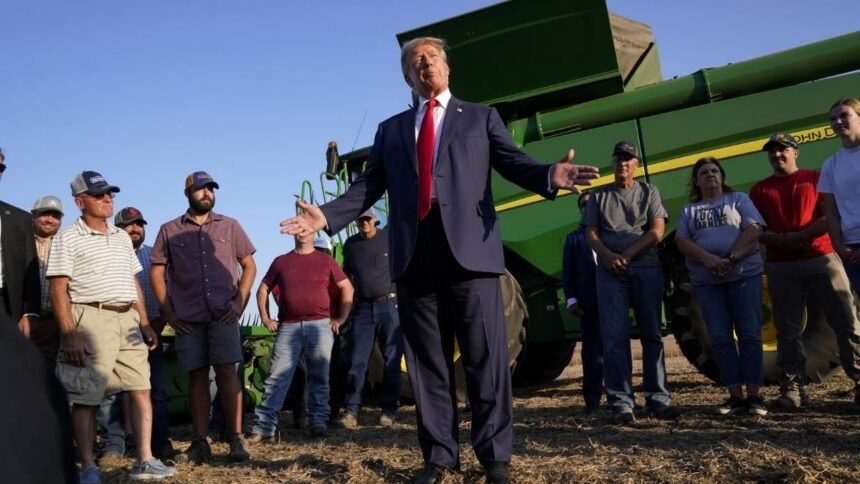
They voted for Donald Trump, They cheered “Liberation Day” in April 2025. They believed, many of them, that his tariffs would finally level a playing field that had tilted against them for years. And then the numbers came in — and rural America began calling what happened next a “perfect storm of ugly.”
The crushing truth is this: American farmers are now living through one of the worst agricultural downturns in recent memory, and the very policy they celebrated — Trump’s sweeping tariff regime — is a driving force behind their pain. In January 2025, the gap between what it cost a farmer to grow a crop and what the market would actually pay for it was essentially zero. By April, that spread had jumped to 12 points. By October, it had exploded to 34 points. Those are not abstract statistics. They are the difference between a family farm surviving and a family farm going under.
Farm bankruptcies rose 46 percent in 2025 — 315 Chapter 12 filings, the highest rate since 2020, and the third consecutive year of increases. America lost another 15,000 farms in 2025 alone, bringing the total farm count from over two million in 2018 to roughly 1.9 million today. The consolidation is not happening because farmers want to grow bigger. It is happening, as agricultural economists bluntly put it, “because producers have to exit, not because they want to.”
The Tariff Math Simply Doesn’t Add Up
Input costs — the seeds, fertilizers, fuel, and equipment parts a farmer needs just to plant a crop — have been driven sharply higher by tariffs on imported goods. At the same time, retaliatory tariffs from trading partners like China have hammered the prices American farmers receive for what they actually sell. The result is a scissors effect: costs going up, revenue going down, and margins disappearing.
Soybean and corn farmers have been hit especially hard. Eighty-four percent of them remain concerned or very concerned about the ability of U.S. soybeans to compete with Brazilian soybeans in the global marketplace — a market China has been steadily redirecting southward since the first Trump trade war in 2018. “Soybean farmers don’t need another trade fight; we need certainty,” Josh Gackle, a North Dakota soybean farmer and president of the American Soybean Association, testified before the U.S. Trade Representative in December. His words landed with the quiet desperation of a man who has watched this movie before.
The Purdue University/CME Group Ag Economy Barometer tells the story of shifting sentiment with cold precision. Farmer optimism over tariffs peaked at 70 percent immediately after Liberation Day in April 2025. By December, it had slipped to 54 percent — and the direction of travel shows no signs of reversing. More than 90 percent of agricultural economists surveyed by the Farm Journal in December identified low commodity prices and high input costs as the primary engine of consolidation in the crop sector. In 2025, crop farmers lost an estimated $34.6 billion, according to the American Farm Bureau.

$12 Billion Is Not Enough
The Trump administration announced a $12 billion relief program through the USDA in December 2025, calling them “bridge payments” for farmers impacted by unfair market disruptions. The Farm Bureau’s president was direct: the money is not enough. “We have faced some tough times across agriculture this year,” he said, “and there’s no sugarcoating that.”
A new survey found that 78 percent of farmers plan to use those government payments not to invest in new machinery or expand their operations, but simply to pay down debt or shore up working capital. The survey’s authors called for “caution,” warning that the share of farmers planning to sell mid- and long-term assets is “climbing toward levels last seen during the 2017–2019 downturn.” Meanwhile, six in ten agricultural economists expect 2026 to bring more of the same — unchanged conditions or something even worse.
The agricultural equipment market is already reflecting that despair. Tractor sales dropped nearly 20 percent compared to 2024. Combine sales fell by 35 percent. Farmers are not buying because farmers cannot afford to buy — and because farmers who are selling off assets are not in the market for new ones.
Rural Economies Are Bleeding Out
The damage extends well beyond the field. A private-sector survey of industrial goods executives found that sentiment in agriculture had collapsed from a rating of 8 out of 10 in 2024 to just 5.7 today, with 63 percent of ag executives expecting revenue to decrease. “The middle is dying,” one agriculture sector executive said plainly, describing how mid-size operations are being squeezed out of existence while large corporate farms absorb what remains. “Time spent on tariffs has left companies essentially stuck in first gear, with severely limited ability to focus on medium- and long-term planning.”
Rural bankers across ten states — Colorado, Iowa, Illinois, Kansas, Minnesota, Missouri, North Dakota, Nebraska, South Dakota, and Wyoming — believe it is unlikely their regions will see meaningful economic growth over the next six months. “Weak grain prices and negative farm cash flows, combined with tariff retaliation concerns, continue to weigh on banker confidence,” their reports note. The forest products sector, another pillar of rural economies, has seen prices drop at least 25 percent and is calling for its own financial relief. Rural communities are also facing a deepening housing affordability gap, with home price increases racing ahead of wage growth in areas where incomes were already thin.

The Health Crisis No One Is Talking About
Behind the tariff headlines and bankruptcy numbers lies a quieter catastrophe unfolding in rural health care. Nearly half of all rural hospitals already operate at a financial loss, and proposed Medicaid cuts threaten to push hundreds more toward closure or a stripped-down model that no longer provides inpatient care. The Rural Health Transformation Fund has helped hospitals supplement state funding, but hospital leaders are clear: it will not offset what federal Medicaid cuts would take away.
The rural health care workforce crisis is structural and severe. While roughly 20 percent of Americans live in rural areas, only 9 to 10 percent of physicians practice there. Urban areas have seven times as many cardiologists as rural areas — even as rural Americans die from heart disease at a rate 21 percent higher than their urban neighbors. Closures of labor and delivery units accelerated in 2025, and in nine states, at least 25 percent of rural hospitals that still provide maternity care have lost money for two consecutive years. Maternal mortality in rural areas is nearly two times higher than in urban areas — and that gap was recorded before this latest wave of closures.
Then there is the insurance crisis that hits farmers with particular force. An estimated four million rural Americans saw their health insurance premiums rise in the marketplace in 2025. Roughly 27 percent of farmers, ranchers, and agricultural managers rely on the individual marketplace for their coverage — compared to just 6 percent of U.S. adults overall. “This isn’t just a farmer problem,” one observer noted. “It’s a problem for millions of Americans who don’t have employer-based insurance. But farmers are right in the middle of it — and the cost is very real.”
Where Does This Leave Rural America?
The both the American Soybean Association and the National Corn Growers Association have been measured but firm in their messaging: government aid payments are welcomed, but they are a bandage, not a cure. What farmers need are stable, long-term markets — both domestic and international — that provide real economic certainty. Agricultural economists surveyed in December echoed that view: “There’s cautious optimism, but very little belief that 2026 will bring a meaningful rebound without cost relief or stronger demand.”
The farmers who voted for Donald Trump were not foolish. They were desperate — desperate for someone to take their decades of economic erosion seriously. What they have received instead is a trade policy that has made their costs go up and their prices go down, a relief check that does not cover the losses, and a rural health care system crumbling under the weight of proposed cuts to the very programs keeping their hospitals open. Rural America believed in the promise. The promise, right now, is delivering something that looks very much like a reckoning.