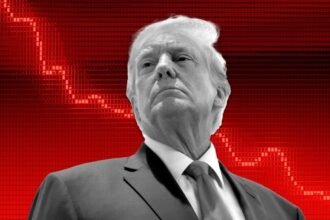

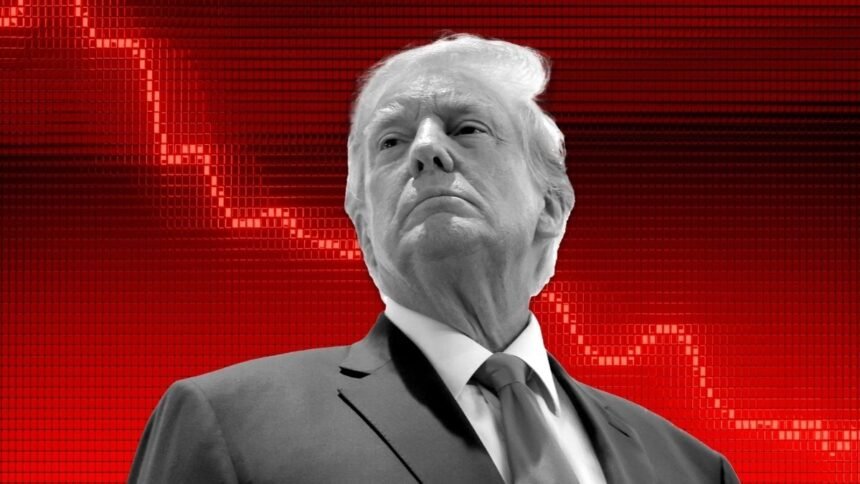
Global stock markets plunged into the red on Monday as the world economy slipped into a state of panic. Investors are now counting the real cost of what Trump has triggered, a chaotic new war in the Middle East that shows no sign of slowing down, and whose spiraling consequences are being felt in every corner of the global financial system.
Asian markets led the early wave of selling. Japan’s Nikkei index fell 7 percent on Monday, following a 5.5-percent drop just the week before. South Korea’s main index dropped 8.2 percent, after already losing more than 10 percent the previous week.
The sharpest blow came from oil. Brent crude, the global benchmark for oil prices, rocketed up 27 percent in a single day to $104.57 a barrel. That is the largest single-day oil price increase since 1988, and it pushed crude back into triple digits for the first time since Russia invaded Ukraine in 2022.
The speed and scale of the oil price surge has alarmed economists and energy analysts alike. Rocketing oil prices directly threaten to push up inflation around the world. That, in turn, forces central banks to raise interest rates, which slows economic growth and squeezes everyday consumers who are already struggling with the cost of living.
RBC Capital Markets analyst Helima Croft put the stakes plainly when she spoke to Reuters.
“Faced with the worst oil supply shock since the 1970s, all eyes will be on Washington’s response. With no clear definition of what winning looks like, it is hard to forecast whether this will be a multi-week or multi-month conflict.”
She did not stop there. Croft also pointed to the White House’s failure to calm nervous investors.
“To date, neither White House policy prescriptions nor upbeat television soundbites have alleviated acute market anxiety about the shipping standstill and cascading shut-ins across the region.”

That anxiety is grounded in very real disruptions on the ground. Iranian forces have responded to U.S. and Israeli strikes by attacking regional oil infrastructure and blocking vital shipping lanes. The most critical chokepoint under threat is the Strait of Hormuz, through which an estimated one-fifth of the world’s entire crude oil supply passes every single year.
The conflict itself began on February 28, when the United States joined Israel in launching strikes against Iran. Since then, those attacks have killed dozens of senior Iranian officials, including Iran’s longtime supreme leader, Ayatollah Ali Khamenei.
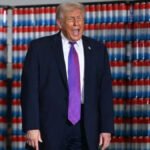
The human cost at home is also growing. At least eight U.S. service members have been killed since the strikes began. Trump himself acknowledged the loss with stark and blunt words, warning that “there will likely be more before it ends. That’s the way it is.”
Back in Washington, the White House has been unable to provide a clear rationale for why the U.S. joined the strikes in the first place. There is also no exit strategy on the table. That silence is only adding more fuel to the financial fire, as investors hate uncertainty more than almost anything else.
The White House did push back on criticism. Spokesperson Kush Desai offered this official response on behalf of the administration.
“The President has been clear about short-term disruptions due to Operation Epic Fury even as U.S. and allied forces make stunning progress against the Iranian terrorist regime.”
Still, Americans across the country are feeling the pressure at the pump and in the grocery store. Gas prices have already climbed sharply as crude oil surges past $100 a barrel. Trump, for his part, has previously dismissed cost-of-living concerns as a Democratic Party “hoax” while claiming to have built “the greatest economy in history.”
American voters, though, do not appear to agree. With inflation fears growing and the war showing no clear end in sight, Republicans are now facing a difficult battle to hold onto control of the House and Senate in November’s midterm elections.
The world is watching, and the markets have already delivered their verdict. What happens next in the Middle East will determine whether this is a short-term shock or the beginning of a prolonged global economic crisis.