
The partial shutdown of the Department of Homeland Security is now leaving tens of thousands of TSA workers without pay, and senators from both parties are sounding the alarm that the longer this drags on, the deeper the economic damage will cut.
Lawmakers are warning that stalled DHS funding is not just a government problem — it is a threat to air travel, business, tourism, and every tax base in the country. And with TSA officers set to miss their first full paychecks this week, the window to act is closing fast.
How We Got Here
DHS funding lapsed on February 14 after Congress failed to reach a deal on immigration enforcement reforms demanded by Senate Democrats. The stalemate centers on the Trump administration’s handling of Immigration and Customs Enforcement and Customs and Border Protection, particularly after two U.S. citizens were fatally shot by federal immigration agents in Minneapolis — an incident that sparked a national backlash and hardened Democratic demands for oversight and reform before any new funding is approved.
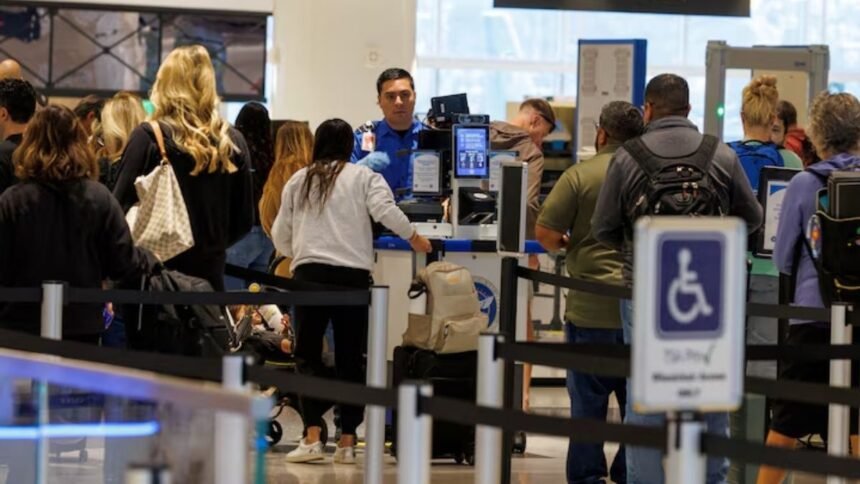
While ICE and CBP officers are continuing to receive paychecks, funded through the $190 billion allocated to DHS under last year’s One Big Beautiful Bill Act, the roughly 61,000 TSA workers who keep America’s airports running are now operating without that safety net. They show up every day, screen every bag, and check every traveler — all without knowing when their next full paycheck will arrive.
Senators Warn of ‘Trillions in Economic Damage’
The human cost is real, but lawmakers are also pointing to something larger. Sen. Jacky Rosen (D-Nev.) put it plainly: “You’re going to shut down trillions of dollars, you shut down our economy by shutting down our airspace.” Rosen, who represents Nevada — a state whose entire economy runs on tourism, conventions, and air travel — warned that the ripple effects would reach every corner of the country. “Every tax base in this country goes down,” she said, describing a domino effect that starts at airport security lines and ends in empty hotel rooms, canceled business trips, and lost local revenue.
Chris Sununu, the former governor of New Hampshire and now president and CEO of Airlines for America, warned in a recent op-ed that America’s aviation system could be “plunged into chaos.” That is not hyperbole. During last year’s record 43-day government shutdown, more than 9,000 flights were delayed or canceled. Air traffic controllers and TSA officers worked the entire time without pay. The same risk is building again, and this time, workers are already exhausted and financially stretched from the last round.
A Possible Fix, but No Deal Yet
Senate Majority Leader John Thune (R-S.D.) and other Republicans are now floating a workaround — shifting some of the $190 billion in DHS funding from the One Big Beautiful Bill Act, money currently going to ICE and CBP, toward keeping TSA workers paid during the shutdown. “I think anything you can do to keep people employed — government shutdowns, nobody wins,” Thune said. Senate Democratic Whip Dick Durbin (Ill.) said he is open to the idea, but only if Republicans show “a good-faith effort” to address ICE’s aggressive enforcement tactics. Sen. Gary Peters (D-Mich.) echoed the same sentiment, saying simply: “TSA agents should be paid.”
Sen. Rosen has gone further, proposing that Congress separate TSA, the Coast Guard, and FEMA from the broader DHS funding fight entirely. “TSA is not part of this,” she said. It is a clean and sensible idea — one that Republicans have so far resisted.
Workers Are Already Feeling It
Behind the political debate are real people. Reuters reported that TSA screeners received only a fraction of their normal pay on February 27. CNN confirmed that some workers have taken out payday loans, while others are worried about making rent and covering childcare costs in March. During last year’s shutdown, TSA officers were reported sleeping in their cars at airports to save money on gas, and selling blood and plasma to get by. That was just months ago. Now they are being asked to do it again.
Sen. Thom Tillis (R-N.C.) warned that once workers start missing full paychecks, the real-world consequences at airports will follow quickly. “If they’re not going to get paid, they may have to do a side hustle or something else,” he said. “These people have lives to live.”
The Bottom Line
Negotiations between the White House and Senate Democrats remain stuck on core issues — oversight, warrants, and enforcement reform. Senate Minority Leader Chuck Schumer (D-N.Y.) said the administration “has not budged” on any key demands. Lawmakers in both parties admit privately they do not see a deal coming anytime soon. In the meantime, the people most hurt by this stalemate are not the politicians arguing over it. They are the workers in blue uniforms, standing at airport checkpoints across the country, doing their jobs — and waiting to get paid.