

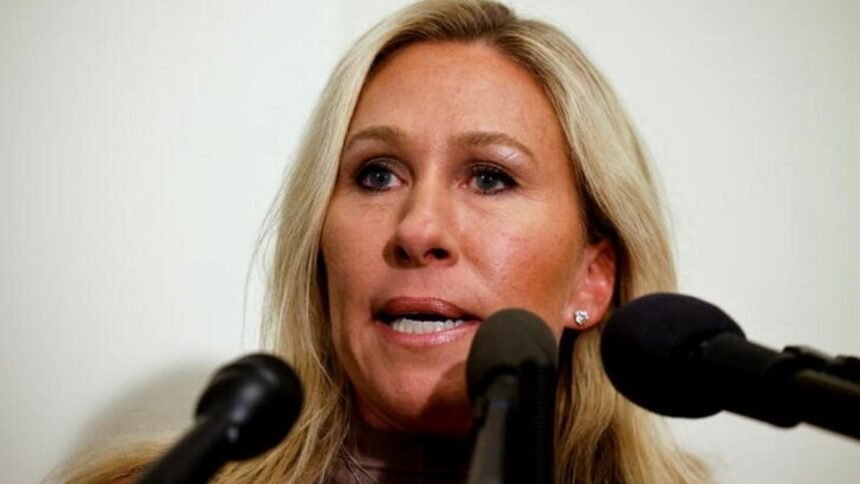
Democrats are racing against time to flip Marjorie Taylor Greene’s former congressional seat in Georgia’s deeply red 14th District. With a special election just days away on March 10, three Democratic candidates are making their final push in a race that, not long ago, nobody would have taken seriously. But something has shifted. The political ground beneath Georgia’s 14th is moving, and both parties know it.
When Greene resigned from Congress in January, as many as 22 candidates immediately lined up to replace her. Twelve remain in the race today. On the Republican side, the crowded field is a serious problem. A badly split vote could hand Democrats an opening they have not had in this district in years. On the Democratic side, there is cautious but unmistakable energy. After years of watching Greene win this seat by margins that made competition feel pointless, her party finally believes a different outcome is possible.
The Democrat With the Best Shot
The strongest Democratic contender is Shawn Harris, a retired brigadier general and cattle farmer who lost to Greene in 2024 but came closer than most expected. He has raised more than $2.4 million in 2026 alone, more than three times what Republican frontrunner Clay Fuller, endorsed by President Donald Trump, has raised. Money does not win elections by itself, but in a low-turnout special election, it buys the ground game and advertising reach that can make all the difference.
Harris is not running a traditional Democratic campaign. He is actively courting Republicans, distributing “Republicans for Shawn” yard signs and speaking directly to voters who backed Trump in 2024 but are growing frustrated with where the party has gone. He told Raw Story that 5 percent of GA-14 voters who backed Trump in 2024 also voted for him, and he believes that number will grow considerably this time around.
“We’re very confident that we’re going to get our Democrats out, the independents out, and those Republicans that feel that the Republican Party has left them,” Harris said. “They’re still Republicans, but the current Republican Party has left them with MAGA, and they’re going to come out and vote for me.”
That message, calm and practical and focused on résumés over rhetoric, is a deliberate contrast to the chaos that defined Greene’s time in Congress.
MAGA Is Losing Its Grip
The Democratic optimism in GA-14 does not exist in a vacuum. It is part of a larger national pattern that has been building since Trump’s re-election. Democrats have now flipped 26 state legislative seats since November 2024. In Texas last month, Democrat Taylor Rehmet flipped a Republican state Senate seat in a district Trump won by 17 points, a result that stunned political observers and sent a clear warning to the GOP about what is coming in November.
In Georgia itself, Democrats recently won two seats on the Georgia Public Service Commission, the first non-federal statewide wins for Democrats in the state in 19 years. That kind of momentum matters enormously in a special election, where turnout is everything and enthusiasm can overcome a structural disadvantage.
Democratic consultant Clarence Blalock, who withdrew from the GA-14 race and endorsed Harris, put the current mood simply. “MAGA’s lost a lot of luster,” he said. “Who wants to be associated with pedophilia? I don’t. I just think people are getting tired of it.” The reference was pointed. Toward the end of her congressional career, even Greene herself had turned fiercely against Trump over his handling of the Jeffrey Epstein scandal, a controversy that continues to shadow the administration today.
The Road Is Still Hard
Not every Democrat in this race shares the same level of optimism. Jim Davis, an author and political scientist running as the third Democratic candidate, built a computer model showing a clear path to victory, but only if two Democrats were competing, not three. With a three-way Democratic split, he believes the odds narrow considerably.
Davis also raised a harder truth about the district itself. GA-14 is working-class, economically strained, and historically skeptical of Democratic messaging on social programs. “They’re hard people because they’ve had a hard time,” he said. “Until Democrats get something in front of that, they’re not going anywhere.”
Patent lawyer Jonathan Hobbs, the third Democratic candidate, takes a longer historical view. He points out that this district leaned Democratic in the 1970s and 1980s, before decades of Republican dominance reshaped its political identity. “Times change,” Hobbs said. “And Trump and Republicans have made a lot of enemies.”
Greene won this seat with 75 percent of the vote in 2020. By 2024, that margin had narrowed to 64 percent, with nearly 135,000 voters choosing Harris, a record for a Democratic candidate in GA-14. The trend line is moving in one direction. Whether March 10 proves that the moment has fully arrived, or merely that it is getting very close, is the question that has both parties watching this small corner of northwest Georgia very carefully right now.