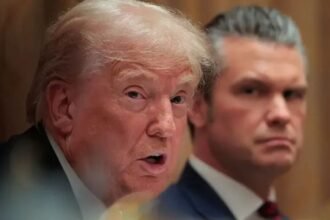

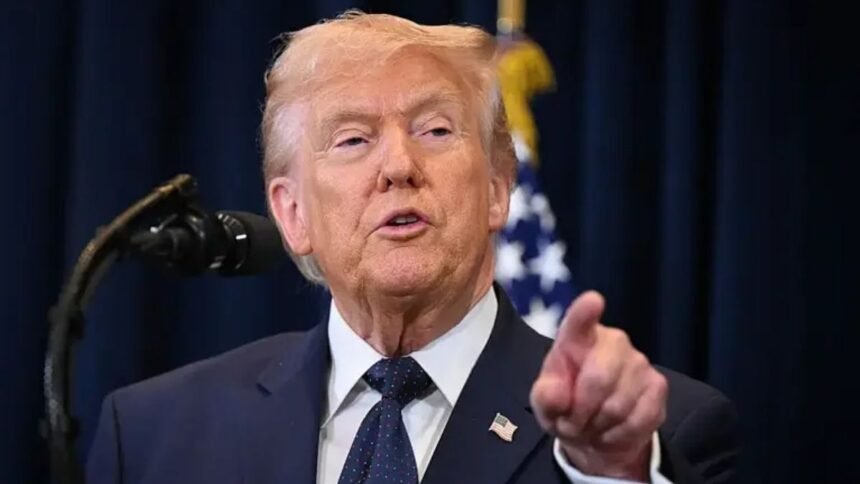
President Donald Trump has long positioned himself as a strong leader, but on Tuesday, a single question from a female reporter left him looking anything but. The moment was brief, uncomfortable, and deeply revealing. It exposed a pattern that keeps surfacing whenever his Iran story gets tested in public.
Trump cut off ABC correspondent Mary Bruce before she could even finish asking her question. She wanted to know whether Iran needed to make a deal for the U.S. to end its military operations, and whether Trump had actually spoken to anyone inside the country. He didn’t wait for her to land the point.
Instead, he launched into a vague, wandering answer about a “new regime” and a supposed gesture of goodwill from Tehran. When Bruce tried to bring him back to the actual question, Trump snapped. What followed was less a response and more a personal attack.
“Wait a minute, you won’t even let me answer the question. You’re a fresh person, you know, we’ve had a lot of problems with you,” Trump said. He then drifted back into rambling claims about Iran being put “into the stone ages.” The exchange quickly went viral.
BREAKING: Trump goes off on a female journalist, first cutting her off, and then calling her a "fresh person" after she asked him a question about Iran that he didn't like.
What a weak, weak man! pic.twitter.com/xIjo2xh0G9
— Ed Krassenstein (@EdKrassen) March 31, 2026The reaction online was immediate and sharp. One widely shared post called Trump out directly: “What a weak, weak man!” Others questioned his credibility after he claimed Iranian leaders had offered him a “present out of respect” following weeks of devastating U.S. and Israeli strikes on the country.
“What sane and rational-minded person really believes the new leaders in Iran actually said, ‘We have a present for you, Mr. President, out of respect,’ to Donald Trump after his administration just decimated their country?” one user wrote. The sentiment reflected a broader distrust that has been building around Trump’s Iran narrative.
The outburst wasn’t an isolated moment. It fit a pattern that critics and journalists have been tracking for months. One response listed the words Trump has used against female reporters over the past year, including “quiet piggy,” “nasty,” “obnoxious,” “third rate reporter,” “ugly,” “terrible,” “unhinged,” and “scum.”
Another response summed up the dynamic plainly: “Everyone knows you cannot dare question the king.” That line captured something real about how Trump handles scrutiny, especially from women in the press corps.
The deeper problem behind Tuesday’s clash is the administration’s confused and shifting account of what has actually happened in Iran. Trump has repeatedly claimed that regime change has already taken place, pointing to the deaths of top Iranian leaders as proof. But that definition bears little resemblance to what the term has traditionally meant.
Regime change, in the standard political sense, requires a fundamental shift in power and ideology. On the ground in Iran, there is little evidence of that. Hard-line figures have stepped into roles left vacant by those killed, and Iran’s ruling structure remains largely intact.
Even Trump’s own officials have acknowledged the uncertainty. Secretary of State Marco Rubio recently described the situation as “very opaque right now,” adding that it’s “not quite clear how decisions are being made inside of Iran.” That admission directly undercuts the confident narrative Trump has been selling to the public.
U.S. intelligence assessments have described the Iranian regime as damaged but still functioning. Analysts say the figures now in control are closely tied to the Islamic Revolutionary Guard Corps and are unlikely to soften their stance. The ideology driving the regime has not changed, regardless of who is sitting at the top.
Trump attempted to reset the story in a national address Wednesday night. He branded Iran’s leadership “the most violent and thuggish regime on Earth” and warned that any move toward a nuclear weapon would cross into what he called an “intolerable threat.” He framed the conflict as nearly resolved, insisting Iran’s military strength had been largely dismantled.
Iranian President Masoud Pezeshkian offered a starkly different view in a letter released ahead of that speech. He cautioned that the world is at a crossroads and described the current path as both unsustainable and self-defeating. The contrast between the two messages could not have been sharper.
What Tuesday’s exchange with Mary Bruce made clear is this: when the questions get specific, Trump gets defensive. A weak man cornered by a straightforward question chose to attack the person asking it rather than answer it. That tells you everything about where this administration stands on Iran, and on accountability.