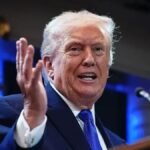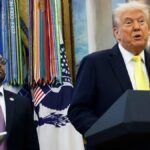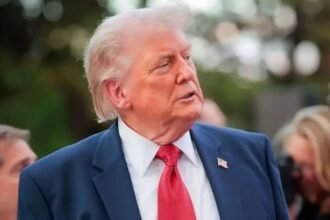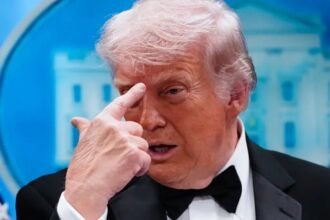

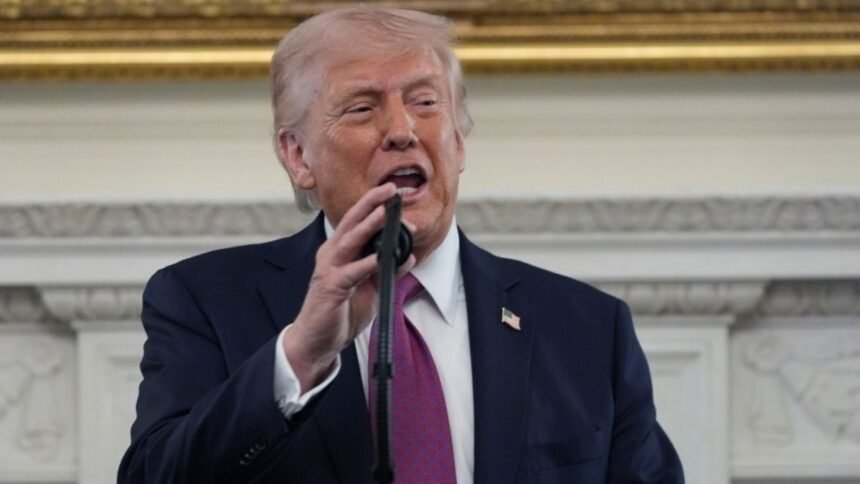
At the White House on Tuesday, Donald Trump looked to many viewers like a man who had completely lost it. In the now-viral clip, Trump goes blank mid-speech and never finds his way back. Students stare in stunned disbelief, and the silence that follows says everything.
What should have been a straightforward, feel-good celebration of NCAA champions became something far more uncomfortable to watch. It turned into a strangely revealing scene about ego, grievance, and a room that simply refused to give Trump the moment he clearly expected. For anyone paying close attention, the event said more about the man behind the podium than it did about the athletes standing in front of him.
The event was designed to honor more than 100 collegiate athletes from seven NCAA title-winning programs. Trump welcomed golfers, volleyball players, tennis teams, bowlers, soccer players, and rifle champions to the White House. He praised their discipline, their training, and their talent in front of the cameras.
But almost from the very start, the focus kept drifting away from the athletes and back toward Trump himself. He talked about the states he won in the last election. He joked that he only likes states that voted for him, drawing an awkward kind of laughter from the room.
He lingered on his own political margins as if this formal White House ceremony were just another campaign stop. Even while introducing championship teams one by one, Trump kept pulling the spotlight back toward his personal victories and his standing with voters. The athletes were physically present in the room, but they often felt more like props in someone else’s monologue than guests being genuinely honored.
That shift mattered more than it might seem on the surface. This was not a rally crowd trained and primed to cheer on command. These were student-athletes from different schools, different sports, and different backgrounds, gathered for a formal White House recognition event. The old habits of applause politics simply do not work the same way when the audience is there to be celebrated, not recruited.
The speech turned most awkward when Trump moved from congratulating the athletes to pushing one of his favorite culture-war lines about transgender participation in women’s sports. He framed the entire issue as proof that his administration was actively “saving” college athletics from chaos. Then he paused, leaned into the moment, and seemed to wait for the room to reward him with applause.
Instead, the moment just sat there, heavy and flat.
“Does anybody agree with that? That men should be able to play in women’s sports. Would you like to raise your hand?”
There was no obvious burst of applause after that invitation. There was no visible rush to meet the cue, no loud show of support that could rescue the line from the silence it had fallen into. The room did not perform the way Trump needed it to.
Trump then tried to answer his own question, claiming he had “never found anybody” who actually disagreed with his position. But by that point, the quiet had already done its damage.
“But you’re politically correct.”
That short, five-word line may have been the clearest tell of the entire event. Trump seemed to realize, in real time, that the reaction he wanted was not coming, so he tried to explain the silence away rather than sit with it. He did not just lose the room for a second. He revealed how deeply his political style depends on immediate emotional validation, and how exposed he looks the moment that validation fails to arrive.
The broader policy context makes this moment even more striking. Trump has spent months turning transgender athletes into one of his most reliable political targets, using the issue at nearly every public opportunity. Reuters reported in February 2025 that the NCAA changed its transgender participation policy just one day after Trump signed his executive order on the issue. That same Reuters report noted that NCAA President Charlie Baker was aware of fewer than 10 transgender athletes competing among roughly 530,000 NCAA competitors total.
That number alone says everything about how tiny the actual population is compared with the enormous political panic that has been built around it. Reuters also reported this month that Trump’s Education Department ended several older civil-rights settlement agreements that had previously supported transgender students in school systems across the country. This White House moment was not an isolated talking point. It was one visible piece of a much wider, coordinated effort to turn a vulnerable group into a permanent political symbol.
The White House has also tried to wrap this same agenda inside a broader message about reforming college sports at large. Earlier this month, the administration released a fact sheet on a sweeping new executive order covering transfer rules, eligibility limits, athlete compensation, and the long-term structure of NCAA athletics. On paper, that gives Trump a rich, substantive platform to stand on and plenty of real issues to discuss with student-athletes directly.
Yet even with all of that material sitting right in front of him, he still drifted back to the same tired applause line. And he found, in front of a room full of quiet, accomplished young athletes, that it no longer landed the way it once did.
That is what made the entire scene feel less like a policy argument and more like a public short circuit. Trump was not interrupted. He was not confronted or shouted down by anyone in the room. He simply hit a moment where the audience would not perform for him, and the gap between his expectation and their response became impossible for anyone watching to ignore.
It also fits a troubling pattern that has followed several of Trump’s public appearances in recent years. PBS NewsHour reported that Trump paced a Detroit rally stage in near-total silence for almost 20 minutes after his microphone failed. Earlier that same year, Newsweek reported on a jarring 30-second pause during his NRA speech in Texas that immediately sparked fresh questions and concern online. Tuesday’s White House moment was different in its cause but strikingly similar in its effect.
Silence has a way of stripping a performance down to its most fragile, unguarded parts.
What the athletes seemed to understand, even if only by instinct in the moment, is that not every prompt deserves a response. They did not need to heckle Trump or make a scene to make the moment uncomfortable for him. They only had to withhold the easy, reflexive applause he has come to expect from every room he walks into.
In politics, that kind of deliberate silence can be far louder than outrage. It does not signal fear, and it does not signal shock. It signals something more damaging than either of those things. It signals distance.
And that is precisely why this clip is spreading. Trump walked into that room expecting to honor student-athletes, sell a familiar political message, and walk out with yet another made-for-television moment of dominance and crowd energy. Instead, he found a much colder and more honest truth waiting for him. When the script falls apart and the crowd refuses to save him, the performance suddenly looks very small, very fragile, and completely, painfully lost.