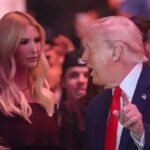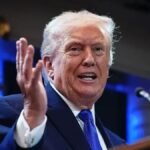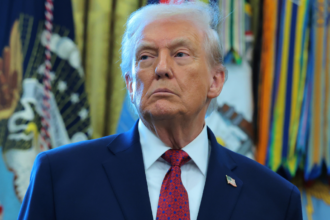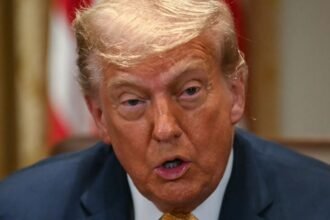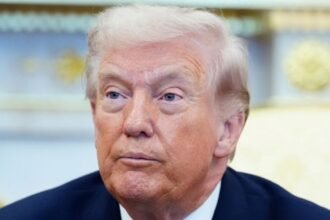

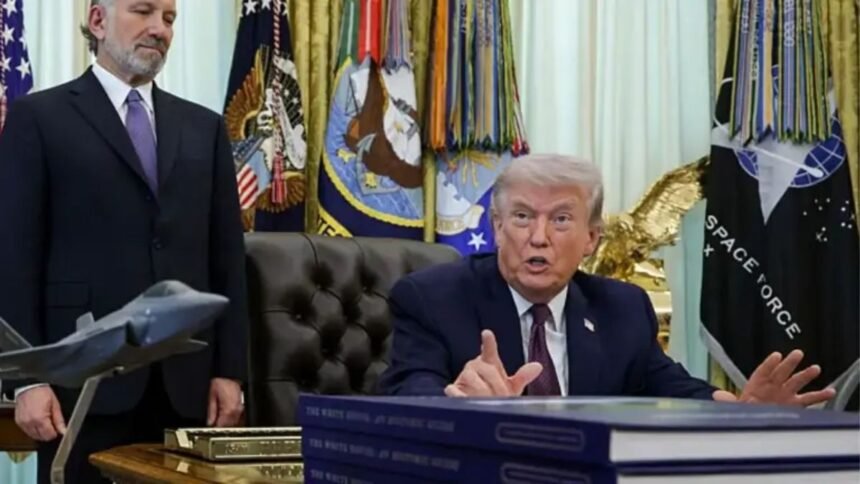
Donald Trump has a well-known way of shutting down a room the moment a question gets too close to the truth. When he decides the conversation is over, the signal comes fast, and everyone in the Oval Office knows it. On April 22, that signal arrived in the form of a thumb pointed at the door and one cold word: “Out.” What followed went viral within hours, and the whole country was asking the same question about the coward who refused to answer.
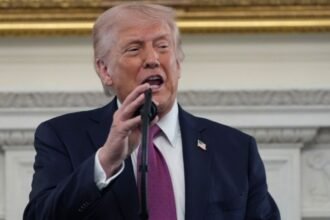
It began four days earlier, on April 18, when Trump gathered reporters in the Oval Office to sign an executive order aimed at accelerating the medical review of psychedelic drugs like ibogaine for treating PTSD, severe depression, and opioid addiction. He gave his remarks, smiled for the cameras, and took a handful of soft questions. The mood in the room was controlled, scripted, and moving exactly the way he wanted. Then came April 22, and the question he did not want anyone to ask.
CBS News White House reporter Olivia Rinaldi had been covering Trump since his 2024 presidential campaign and knew how these rooms worked. She graduated from the University of Virginia in 2019 with a degree in foreign affairs and media studies, and she had spent years learning how to hold her ground. When the moment came, she did exactly that. She stepped forward and refused to back down.
Rinaldi was asking about reports that Iranian Revolutionary Guard gunboats had fired on vessels crossing the Strait of Hormuz earlier that morning, a direct and urgent question tied to an active and unhinged military conflict overseas. She began clearly and calmly: “Mr. President, a question on Iran. Iranian gunboats fired upon two vessels today. President Macron said…” Trump cut her off before she could finish.
Special Assistant to the President and Director of Media Affairs Sonny Joy Nelson immediately stepped forward as Trump waved the exchange away without a word of response. Trump then motioned with his thumb toward the door, said “Out,” and followed it with a flat “Thank you very much.” Rinaldi did not flinch or stop. She kept trying to ask her question even as Nelson moved in to escort her from the room.
"Out"
Bro can't handle the questions that test his false reality. pic.twitter.com/dWR5caHE0p
— Anonymous (@YourAnonNews) April 22, 2026The video said everything words could not. Trump turned his body away from Rinaldi as she was walked out, and the cameras captured a silence where an answer should have been. No response, no explanation, nothing. Just a reporter removed from the room for asking a real question about a real war.
Once CBS and Rinaldi shared the footage online, reactions poured in almost immediately. Two clear waves of commentary formed, one focused on press freedom, the other aimed directly at Trump himself. Neither wave was quiet.
On Instagram, one viewer wrote in a post, “Journalist just stating a FACT. Why does he want her thrown out?” On X, another commenter was saying something sharper, writing, “Reporters need to keep asking the question until he answers it. He can kick them all out but that looks way worse on him than them.”
A third voice put the frustration into words many people recognized. “Isn’t it funny the second anyone speaks facts or fact checks his fat @$$ it’s instant attack and or be ushered out,” the comment read. “Wake the f–k up.”
View on Threads
On Threads, the reaction carried a sharper political edge. One user wrote, “He knew the press pool was going to ask him about Iran, so he made sure to kick them out before they could ask.” Another was posting that the move was calculated, calling the press shutdown “immensely smart” while still describing Trump as “a nightmare.”
A final comment captured the raw anger many people felt watching the clip travel across every platform. Writing with barely contained fury, one user said, “Look at the coward. He’s too afraid to answer questions on why America got its a– kicked in Iran.”
For White House reporters, the scene felt deeply familiar, not shocking. This is a pattern, not an accident. Over 250 veteran journalists recently signed a letter urging the White House Correspondents’ Association to confront Trump directly over his ongoing attacks on press freedom. The letter included names like Dan Rather, Ann Curry, and Sam Donaldson.
The history of these confrontations stretches back clearly and keeps growing longer. On April 6, during a press conference on the ongoing war in Iran, Trump was asked by New York Times reporter Zolan Kanno-Youngs whether certain military actions could violate international law. Trump refused to answer and instead went after the paper’s credibility. He dismissed Kanno-Youngs repeatedly while continuing to speak as if the question had never been asked.
A separate incident from 2025 still travels online and draws fresh outrage every time someone new discovers it. Bloomberg’s Catherine Lucey tried to follow up on a question about the Epstein files while aboard Air Force One. Trump’s response came in three words: “Quiet, piggy,” mocking her appearance in front of the entire traveling press corps. The clip still circulates regularly and still draws the same wave of disbelief every time.
The question Rinaldi tried to ask that day was not hypothetical or provocative. It was grounded in real and confirmed events. Reports indicate that on April 22, Iranian Revolutionary Guard gunboats opened fire on at least three commercial ships crossing the Strait of Hormuz, with maritime security sources confirming the attacks. The incident sharpened tensions in a region already pushed to its limits by weeks of active conflict. The question deserved an answer, and the president of the United States walked away from it.
That is what kept people talking long after the clip stopped trending. It was not just the unhinged meltdown caught on camera, the thumb at the door, or the escort out of the room. It was the deafening silence on the other side of a simple, honest question that told the most important story of all.