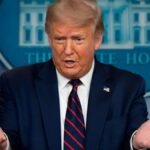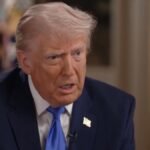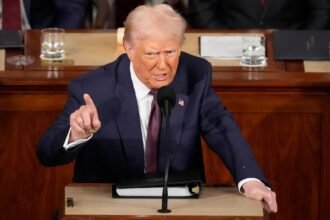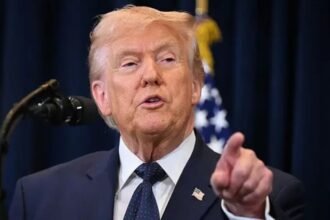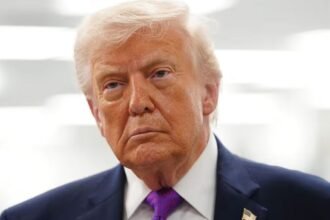

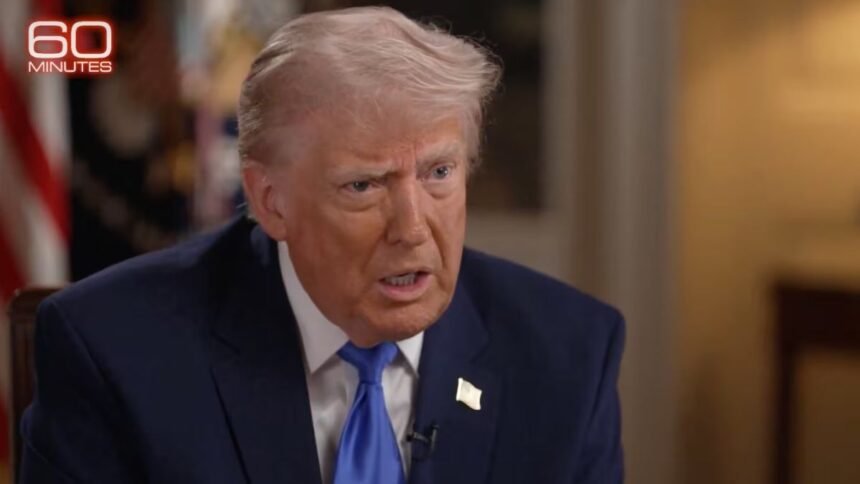
President Donald Trump did not just lose his composure during a 60 Minutes interview with correspondent Norah O’Donnell. He completely unraveled, on live television, in front of the entire country. The moment was raw, deeply uncomfortable, and for millions of Americans watching at home, absolutely impossible to look away from.
It started when O’Donnell sat down with the 79-year-old president to discuss the shooting that erupted near the White House Correspondents’ Association dinner on Saturday night. The suspected gunman, 31-year-old Cole Tomas Allen, had allegedly sent a manifesto to his family just moments before opening fire. O’Donnell brought that document directly into the room with Trump, and that is when everything changed.
O’Donnell read aloud from Allen’s alleged writings, quoting his stated motive that he was “no longer willing to permit a pedophile, rapist, and traitor to coat my hands with his crimes.” She then asked Trump directly how he felt about those words. What came next was one of the most explosive moments ever captured in a presidential interview on American television.
“I was waiting for you to read that because I knew you would, because you’re horrible people. Horrible people,” Trump shot back immediately. He then denied each label in quick, sharp succession. “I’m not a rapist. I didn’t rape anybody,” he said, his voice rising with each word.
When O’Donnell gently asked whether Trump believed Allen had been referring to him personally, Trump did not pause. He cut her off and said, “I’m not a pedophile,” repeating the phrase twice in a trembling, elevated voice. “Excuse me. Excuse me. I’m not a pedophile.” The denial landed hard, and the clip began spreading across social media within seconds of airing.
Trump then directed his anger at O’Donnell herself and at the CBS News network. “You read that from some sick person? I got associated with stuff that has nothing to do with me,” he said. “You should be ashamed of yourself reading that because I’m not any of those things.” He called her a disgrace not once, but twice, before telling her to finish the interview anyway.
The outburst left America speechless not just because of its intensity, but because of the years of context sitting behind it. Trump has faced long-standing and serious scrutiny over his ties to convicted sex trafficker Jeffrey Epstein, a relationship that spanned nearly two decades and was well documented in photographs and public records. In early 2026, the Department of Justice released over 3.5 million pages of Epstein-related files, with Trump’s name appearing more than 1,000 times throughout those documents. Trump has denied any wrongdoing and has not been charged with any crime.
There is also the matter of a 2019 FBI interview in which a woman accused Trump of sexually abusing her when she was just 13 years old. Trump has vehemently denied that allegation. No criminal charges have been filed in connection with that claim.
In 2023, a New York civil jury found that Trump had sexually abused journalist E. Jean Carroll in 1996. Carroll was first awarded $5 million after that jury found Trump liable for sexual assault. A second jury later added $83.3 million in defamation damages, and Trump failed in his bid to overturn that massive verdict in court.
It is against that long and well-documented backdrop that O’Donnell’s questions carried so much weight. She was not reading a random accusation from a stranger. She was reading the stated motive of an alleged gunman who had just attempted to storm a hotel where the sitting president of the United States was scheduled to speak. The questions were unavoidable, and Trump’s reaction told its own story.
The manifesto itself contained more than just Allen’s stated reasons. The document listed Trump administration officials as prioritized targets, ranked by seniority, while making clear there was one Trump official who was not a target. That individual was FBI Director Kash Patel, whom Allen reportedly named explicitly as exempt from the list.
Allen’s alleged writing also exposed a deeply alarming security failure at the event itself. He described walking into the Washington Hilton, armed with a shotgun, a handgun, and multiple knives, without a single person stopping him or inspecting his luggage. “No damn security. Not in transport. Not in the hotel. Not in the event,” he allegedly wrote, adding bluntly, “What the hell is the Secret Service doing?”
A journalist present at the dinner later confirmed that Allen had sprinted past the same magnetometers that other attendees walked through normally. That checkpoint, it appears, was the only real security barrier standing between an allegedly armed man and a room full of government officials and the president himself. The revelation raised urgent and deeply serious questions about how such a catastrophic lapse was allowed to happen.
Trump’s fury during the 60 Minutes interview was visible, raw, and unfiltered. But the fury alone cannot erase the questions that made the interview necessary in the first place. The denial echoed loudly across the country. Whether America found it convincing is an entirely different question — and one that is far from settled.