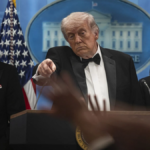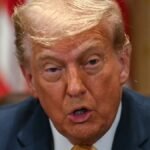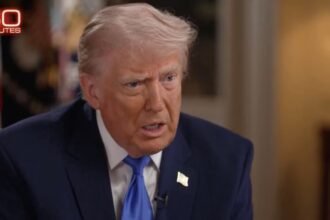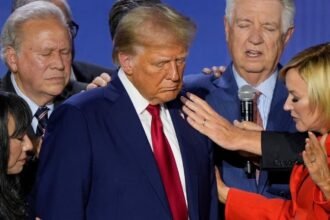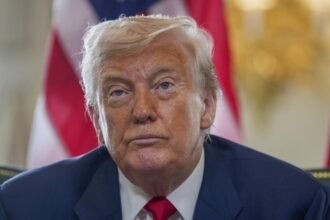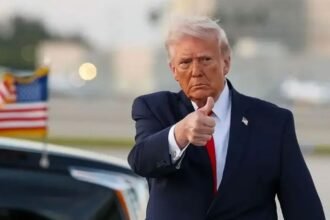

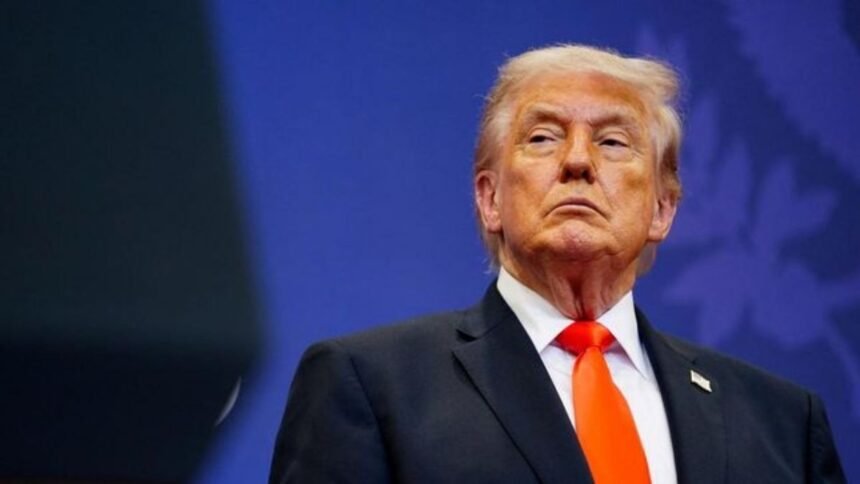
Donald Trump stepped away from reporters on the White House lawn on Friday and walked toward Marine One, heading to an LIV Golf dinner in Sterling, Virginia. What happened next has since been watched, rewound, and debated across social media. A short clip of that walk is now at the center of a growing conversation about the president’s physical fitness and whether the alarms being raised deserve more serious attention.
The footage shows Trump turning from a small group of reporters and moving toward the waiting helicopter while cameras kept rolling. The clip was posted on X with the simple caption “Trump walks away.” Almost immediately, people stopped paying attention to what he had just said and started focusing entirely on how he moved.
One user summed it up with two words: “zigzags away.” That throwaway phrase quickly became the shorthand label for the clip as it spread across social media. Another user said it was shocking that he “didn’t fall flat on his face walking to the plane,” claiming he appeared to be limping and unable to hold a straight path toward the helicopter.
A third account went even further, posting that “Trump struggles to walk straight” and claiming he had “effectively zero mobility.” These are sweeping judgments pulled from just a few seconds of video. But they are landing hard with people who already believe his physical condition is quietly declining.
The concerns did not stay buried in comment sections. MeidasTouch, one of the most widely followed progressive political accounts on X, pulled the thread together in a single post that has since been viewed and shared widely.
Donald Trump’s recent public appearances continue to raise serious questions.
He has repeatedly appeared unable to walk in a straight line, his hands have shown visible discoloration covered by heavy makeup, and his speech has become increasingly erratic.
This week, he also… pic.twitter.com/FmdLaYGmzQ
— MeidasTouch (@MeidasTouch) May 9, 2026The post pointed to three separate concerns at once: his walking pattern, visible discoloration on his hands reportedly covered by heavy makeup, and what the account described as increasingly erratic speech. Whether or not those claims hold up to scrutiny, the post reflects how quickly individual moments are being stitched together into a broader narrative about the president’s health.
No official statement has addressed this specific walk across the South Lawn. No aide, staffer, or White House spokesperson has offered even a simple explanation, such as uneven ground, a cable, or an awkward camera angle. That silence has only added fuel to the fire.
Critics who believe Trump’s health is deteriorating are treating the clip as confirmation. His supporters say the footage shows nothing unusual and accuse opponents of trying to diagnose the president through a smartphone screen. With no verified medical assessment connected to the incident, nothing is confirmed, and the video remains open to interpretation.
This latest moment did not arrive in isolation. Last month, Trump drew similar scrutiny after he stepped off Air Force One in Phoenix, Arizona, and paused to take questions from reporters on the tarmac. Cameras caught him standing with his feet spread unusually wide apart, pointing outward in a V-shape beyond his shoulders, with his arms hanging straight at his sides.
That image took on a life of its own on X. Stripped of context, it was paired with waves of commentary about balance, stiffness, and age. Some users argued he looked like he was bracing himself just to stay upright. Others dismissed it as an unflattering frozen frame of the kind any public figure risks when cameras are firing continuously.
Put side by side, the Phoenix stance and the Marine One walk have become a small but growing file for those convinced the president is struggling physically. Threads collecting both clips present them as part of a pattern, pointing to the wide-legged pose on the tarmac and the apparent veering on the lawn as hints of an underlying issue with stability. It is amateur detective work dressed up as medical diagnosis, with people studying posture and foot placement as if they were reading scan results.
Supporters have a counter-argument ready. They point out that crossing the South Lawn means navigating uneven grass, dealing with the noise and wind from the helicopter, and walking while cameras and shouted questions follow your every step. Under those conditions, they argue, a wandering line or a careful step is not proof of poor health. In their view, the obsession with his gait says far more about his opponents’ desire to find fault than about any real medical concern.
The problem is that none of these arguments is backed by any doctor who actually treats Trump. Every conclusion being drawn is based on visual impressions and political loyalties, not medical records. That doesn’t stop people from treating the clips as hard evidence. But it does make every conclusion built on them deeply unreliable.
The most striking part of this story is the contrast it creates. On the same Friday evening that the zigzag footage was being replayed and captioned online, Trump was standing in front of microphones discussing some of the most serious issues facing the country. He told reporters he expected Iran to respond to Washington’s latest proposal on the Middle East by that night. “I’m getting a letter supposedly tonight, so we’ll see how that goes,” he said. When pressed again on Tehran’s timeline, he repeated, “We will see how it goes.”
He also spoke about Russia and Ukraine after both countries confirmed a United States-brokered three-day ceasefire running from May 9 to May 11. Trump had announced the temporary pause earlier on Truth Social, saying each side would exchange 1,000 prisoners of war during the window. Speaking to reporters that evening, he said he hoped the ceasefire would last much longer, adding, “I’d like to see a big extension. It could be.”
So within a single news cycle, the same man was both fielding questions on Iran, Ukraine, and prisoner swaps and being described online as someone who could not walk in a straight line. His supporters point to that packed public schedule as proof that he is more than capable of handling the demands of the presidency. His critics say that talking fluently about foreign policy does not cancel out what they see as visible warning signs in his movement and posture.
The real problem running through all of this is simple. There is no current, detailed medical information on the record that could settle the debate either way. The fight over Trump’s physical fitness is being fought through video snippets, frozen frames, and captions on X, not through doctor’s reports or official health disclosures. Until his physicians provide updated assessments that can be weighed against the claims circulating online, the clip of him losing his mind over the path to Marine One will remain exactly what it is now: one more contested fragment in a debate driven far more by politics than by anything a doctor has actually said.