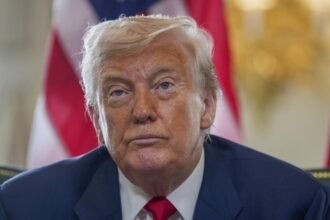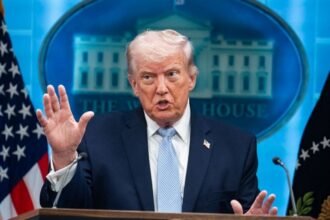

Any photo of Donald Trump comes with an unspoken disclaimer these days. His team appears convinced that a pressed blue suit, his signature comb-over, and rapid-fire remarks are enough to steer the public’s gaze away from what is happening to his body. In reality, those very choices draw attention to everything they are trying to hide. The more they deflect, the more people look at his hands.
Trump’s orange-stained complexion has been normalized to the point of becoming a punchline. But recent close-up photographs have reignited serious concern among medical observers and the general public alike. Brutal, unedited images continue to raise red flags that no amount of stage management can fully suppress.
The 79-year-old president has repeatedly boasted that he aces cognitive tests without breaking a sweat. He is also convinced that layers of makeup are doing the job of concealing what he does not want anyone to see. Neither claim holds up under a zoom lens.
On May 11, Trump shrugged and waved off reporters during a routine walk to Marine One on the White House’s South Lawn. A single snapshot of his right hand, taken by AFP photographer Kent Nishimura, went viral almost instantly. It circulated just as headlines were already heating up over his planned meeting with Chinese President Xi Jinping.
The image was hard to look away from. It showed deep wrinkles, thinning skin stretched tightly over tendons, blotchy concealer, red-purple bruising, and what appeared to be a presumed puncture wound. Viewers across social media described the sight in visceral, unfiltered terms.
The White House had to admit Trump has chronic venous insufficiency. His body shows what they tried to hide: swelling hands, bruises under makeup. The lesions they called preventative care.
A 79-year-old man rots at the empire's podium & we're told to act like all is well. pic.twitter.com/JppPsOmfOD
— Patrick S. Bruck (@PatrickSBruck) May 13, 2026One X user, Patrick S. Bruck, put it plainly: “The White House had to admit Trump has chronic venous insufficiency. His body shows what they tried to hide: swelling hands, bruises under makeup. The lesions they called preventative care. A 79-year-old man rots at the empire’s podium and we’re told to act like all is well.”
Journalist Aaron Rupar reshared the viral photographs and added his own caption: “A look at Trump’s disfigured right hand as pictured yesterday by Kent Nishimura of AFP.” The post spread rapidly, pulling in reactions from thousands of users within hours.
To date, the only condition the White House has officially disclosed is chronic venous insufficiency, a circulatory disorder that causes blood to pool in the lower extremities and can lead to visible swelling, bruising, and skin discoloration. It is a real and recognized condition, but it does not fully explain what viewers are seeing on Trump’s hands in these close-up images.
Trump’s defenders moved quickly to shut down the conversation. One user on X insisted the condition was simply “arthritis from shaking many hands and signing many documents.” Others were less charitable. One commenter wrote plainly: “Oh my eyes. My eyes.” The reaction captured something many viewers felt but could not quite put into words.
White House Press Secretary Karoline Leavitt had previously attributed the visible contusions to “vigorous handshaking.” That explanation landed with skepticism then and has aged even worse now, as the visible damage on Trump’s hand has continued to worsen with each new public appearance.
Trump himself attempted to explain the bruising by pointing to his daily aspirin use. He said, “I take the big aspirin. And when you take the big aspirin, they tell you, you bruise.” White House physician Dr. Sean Barbabella confirmed in 2025 that Trump takes aspirin “as part of a standard cardiovascular prevention regimen” to prevent blood clots. Trump echoed that framing, saying the drug stops his blood from becoming thick and sluggish.
OMG: The sculptor behind the 22-foot golden statue of Donald Trump unveiled this week says he was instructed to make Trump look thinner and to “get rid of the turkey neck.”
Veteran sculptor Alan Cottrill says the project quickly descended into what he described as a… pic.twitter.com/m3u66Bdaiy
— Kimiyah 💋 (@boujiebaddie) May 10, 2026The aspirin argument has not satisfied critics, particularly now that the bruising appears to be spreading rather than healing. According to the Cleveland Clinic, untreated chronic venous insufficiency can lead to broken capillaries, tissue damage, and in advanced cases, open ulcers. Doctors observing from the outside are asking questions that the administration has shown no interest in answering.
On Instagram Threads, one user speculated that Trump “got his infusion again,” adding, “wonder if he has cancer.” The comment drew thousands of responses, mostly from people who said they had already been thinking the same thing. Others kept it shorter: “He’s rotting.”
The administration has essentially stopped trying to give coherent explanations. Official statements have become more dismissive with each round of new photographs. Meanwhile, the public continues to zoom in, document, and share what they see with their own eyes.
What is undeniable is that the gap between the White House’s messaging and visual reality keeps growing. Trump’s doctors are saying he is in “excellent health.” His hands are telling a different story. And nobody in an official capacity seems eager to reconcile the two.
His viral moments keep coming, one appearance at a time. Critics have made peace with the fact that each public outing will produce something new to scrutinize. Whether it is his words, his posture, or now the visible condition of his hands, the camera catches what the suits and the spin cannot cover.