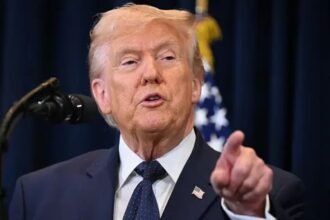

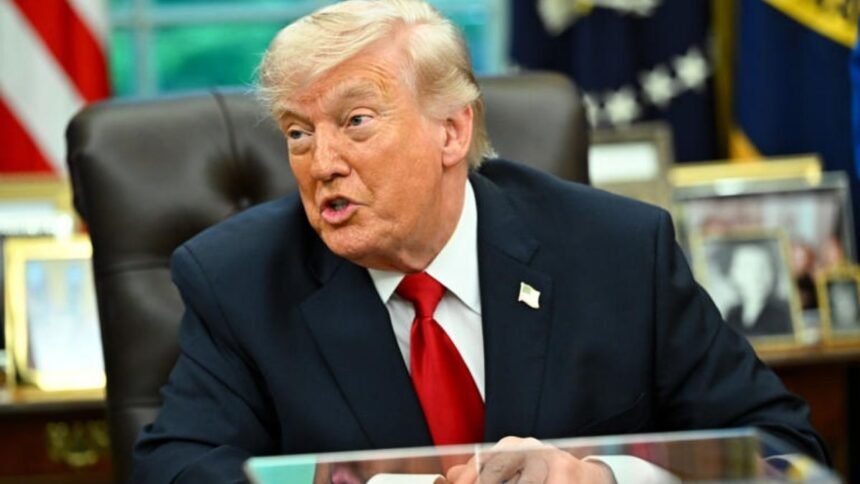
Donald Trump has long moved in circles defined by wealth and influence. It is a world that rarely mirrors everyday life in America. That gap snapped into sharp focus on live TV when he was forced to read from his own prepared remarks. For millions of Americans watching, it was a moment that felt less like a slip and more like a window into something much deeper.
At a tax roundtable in Las Vegas on April 16, Trump was on camera promoting his so-called “Big Beautiful Bill.” He bragged about sweeping tax cuts for American workers and small businesses. He read from a prepared statement listing “restaurants, dry cleaners, and some corner stores.” Then came the moment that broke the internet.
He stopped mid-sentence, looked up from the page, and asked out loud in front of the entire room. His words landed like a thunderclap across social media within minutes. He had snapped on camera, and the whole country was watching.
“What is a corner store? I’ve never heard that term. A corner store. Who the hell wrote that, please?”
That single question, caught live on camera and shared instantly across every platform, set the internet on fire. The clip spread faster than any campaign ad his team could have produced. Within hours, it had become the most talked-about moment of his presidency that week.
Trump: “Millions of American small businesses, including corner stores. What is a corner store? I’ve never heard that term. I know what a corner store is but I’ve never heard it described– a corner store. Who the hell wrote that?” pic.twitter.com/meTSMHxdX0— Aaron Rupar (@atrupar) April 17, 2026
Trump: "Millions of American small businesses, including corner stores. What is a corner store? I've never heard that term. I know what a corner store is but I've never heard it described– a corner store. Who the hell wrote that?" pic.twitter.com/meTSMHxdX0
— Aaron Rupar (@atrupar) April 17, 2026The room laughed in the moment. But online, the reaction was something else entirely. What started as a routine political appearance on live TV quickly spiraled into a full-blown viral moment. Critics immediately pointed to the exchange as proof of a president completely out of touch with working-class America.
Television personality Don Lemon shared the clip on Instagram, writing plainly: “Trump is from NYC and doesn’t know what a corner store is.” The post spread across platforms within hours. Millions of people watched and reshared the clip without needing to add a single extra word.
“Happy Days” actor Henry Winkler kept his response short and cutting, tweeting just three words: “In touch with America.” Those three words captured exactly what millions of everyday Americans were already thinking. The sarcasm was impossible to miss.
Their responses pushed the exchange far beyond a simple camera moment. It became a cultural flashpoint about class, wealth, and the growing divide between the president and the people he governs. Commentators across television and digital media called it one of the most revealing moments of his entire presidency.
Across social media, everyday Americans filled in the rest of the story. One commenter wrote, “In a stunning moment of ignorance, Trump reveals that he does not know what a corner store is.” Another added, “I wouldn’t normally say this, but hopefully he knows what a bodega is.” The comments poured in by the thousands within the first hour alone.
Someone else said in disbelief: “Despite being from NYC, Donald Trump doesn’t know what a corner store is.” Another person wrote, “In New York, they call them bodegas, but still, it should not have been an alien term to him.” The city Trump grew up in runs on corner stores and bodegas at nearly every block.
One commenter noted sarcastically: “The rambling senior citizen with dementia babbles nonsense on TV and poops himself again. Fixed the article’s title.” Another user blasted, “He’s totally clueless about how the majority of American citizens live.” The critics were not holding back, and the comment sections kept growing by the hour.
This was not a one-time slip on camera. A pattern of disconnection has been building steadily across Trump’s presidency. His own supporters are beginning to notice, and the frustration is showing up in spaces that used to be filled with nothing but praise.
During a separate exchange about rising costs and affordability, Trump said something that also raised eyebrows across the country. He described the word “groceries” as if he had just discovered it, calling it “sort of an old-fashioned word, but very accurate.” The comment lingered online for days and sparked its own separate wave of disbelief from both sides of the aisle.
Then came the marble bathroom discussion. Photos circulated showing a polished, expensive renovation inside the White House. For families balancing rent, utilities, and weekly food bills, the image felt tone-deaf and deeply disconnected from their daily financial reality. The contrast between White House marble and kitchen table budgets was impossible to ignore.
The president who built his entire brand on real estate expertise appeared out of touch when discussing one of the biggest financial decisions ordinary Americans ever face. While pitching a proposed 50-year mortgage, he reduced the entire concept to a single dismissive line. He seemed completely unbothered by the math behind it.
“All it means is you pay less per month,” Trump said confidently on camera.
When Fox News anchor Laura Ingraham pressed him directly, asking whether the plan was simply a giveaway to the banks, Trump pushed back without a moment of hesitation. He did not acknowledge the long-term costs. He did not mention the numbers that quietly tell a very different story.
“It’s not even a big deal,” he insisted. “You go from 30 to 50 years, you pay something less per month. It might help a little bit.”
But the math tells a completely different story. According to NPR’s detailed analysis, buyers on a 50-year loan would pay nearly $378,000 more in total interest compared to a standard 30-year mortgage. That is not financial relief for struggling families. That is a debt trap dressed up as a helping hand.
For working-class families already stretched thin by inflation and housing costs, the gap between what Trump says on camera and what the numbers actually show is impossible to ignore. Economists and housing advocates have warned that extending mortgage terms does not solve the affordability crisis. It simply delays and multiplies the financial pain for the people least able to absorb it.
Critics across the political spectrum are now pointing to the corner store moment as something far more significant than a verbal stumble. They argue it is part of a larger, undeniable pattern of a president who does not understand how most Americans live, shop, or pay their bills. The live TV meltdown, they say, was not an accident.
The corner store comment has become a symbol of something far bigger than vocabulary or word choice. It is a symbol of how closely, or how loosely, a sitting president stays connected to the real routines of the people he was elected to serve. One simple phrase on a prepared page revealed a divide that no press conference can fix.
For many Americans watching that live broadcast, the real question was never about a single word. It was about whether the man reading from that page has any genuine understanding of how most people in this country actually live, shop, and survive each week. Based on what millions saw on camera that day, critics say the answer is becoming harder and harder to defend.