

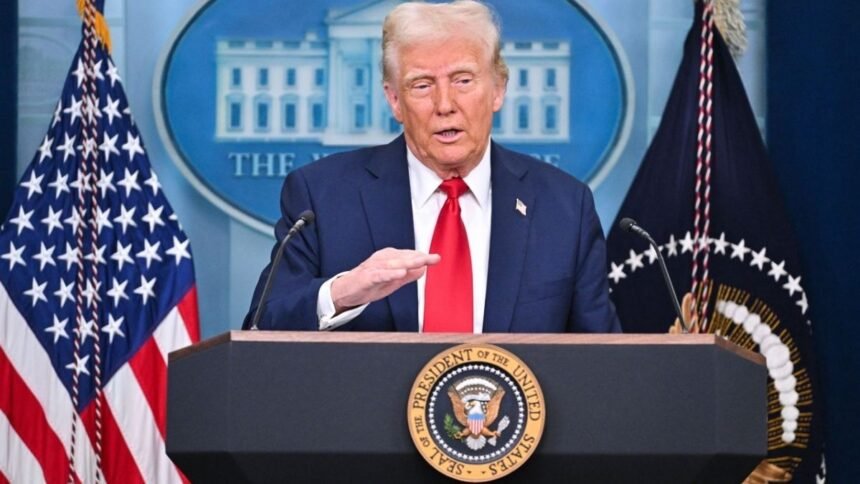
President Donald Trump stood in front of reporters on Friday, May 1, and declared himself above the law. He said he did not need congressional approval to keep his Iran war going. At that very same moment, his own defense secretary was sitting in a Senate hearing room accidentally blowing that entire argument apart.
Trump was asked directly whether he planned to seek congressional authorization to continue the military campaign against Tehran. He had launched the war on February 28 without congressional approval, a move that legal experts say likely violated the War Powers Resolution. That law has been on the books since 1973 for exactly this reason.
Under the resolution, a president has 60 days to either get congressional approval or request a 30-day extension. If neither happens, the law requires the president to end the military engagement. The law was written specifically to stop presidents from dragging the country into wars without the consent of Congress.
Trump was not interested in any of that.
“Nobody’s ever gotten it before. They consider it totally unconstitutional, but we’re always in touch with Congress. But nobody’s ever sought it before or asked for it before. It’s never been used before. Why should we be different?” Trump told reporters, dismissing the legal requirement entirely.
That claim, however, is simply not true. After the September 11 attacks in 2001, President George W. Bush went to Congress and received formal authorization for the War on Terror. Congress also passed a resolution authorizing his father George H.W. Bush’s Gulf War back in 1991. The War Powers Resolution itself was enacted because multiple presidents failed to seek approval during the Vietnam War, a conflict that dragged on for nearly 20 years.
Trump was busy rewriting history on one end of Washington. Meanwhile, Pete Hegseth was doing something entirely different on the other end.
On Thursday, April 30, Hegseth appeared before a Senate committee for testimony. Instead of backing Trump’s claim that no approval was needed, Hegseth seemed to acknowledge that the War Powers Resolution deadline was real. He just came up with a creative reason for why it did not apply right now.
“We are in a ceasefire right now, which to our understanding means the 60-day clock pauses or stops in a ceasefire,” Hegseth said, with a straight face, to a room full of senators.
HEGSETH: On Iran, we are in a ceasefire right now, which I understand means the 60 day clock pauses or stops
KAINE: I do not believe the statute would support that pic.twitter.com/1JGdThEdR9
— Aaron Rupar (@atrupar) April 30, 2026That statement immediately put Senate Democrats on high alert. Virginia Democratic Senator Tim Kaine pushed back without hesitation. Kaine has been one of the most vocal critics of Trump’s unauthorized use of military force, and he was not about to let this one slide.
“We’re right at the 60-day deadline. Is the president intending to either seek congressional authorization or send us the legally required certification that he needs an additional 30 days to remove U.S. forces from the war?” Kaine asked directly.
Hegseth’s response was to deflect and repeat himself.
“On Iran, ultimately, I would defer to the White House and White House counsel on that. However, we are in a ceasefire right now which our understanding means that the 60-day clock pauses or stops in a ceasefire. It’s our understanding just so you know,” Hegseth said, even as Kaine tried to interject.
Kaine was not satisfied and made his position crystal clear.
“I do not believe the statute would support that. I think the 60 days runs maybe tomorrow and it’s going to pose a really important legal question for the administration. We have serious constitutional concerns and we don’t want to layer those with additional statutory concerns,” Kaine responded.
The problem for Trump was now painfully obvious to anyone paying attention. While Trump told reporters he did not need congressional approval at all, Hegseth was in the Senate effectively admitting that the War Powers Resolution was real and relevant, then trying to find a legal workaround. The two men were not telling the same story.
Republicans who have been quietly nervous about the administration’s legal footing on the Iran war now had something new to worry about. Their own defense secretary had just handed Democrats a sharper argument in the ongoing constitutional standoff over war powers.
Social media erupted almost immediately after the exchange became public.
“He has a majority in both houses and he’s still afraid they won’t do what he says,” one Threads user pointed out.
Another user quoted Abraham Lincoln to make the point land harder. “We the people are the rightful master of both Congress and the courts, not to overthrow the Constitution, but to overthrow the men who pervert the Constitution.”
On X, the reaction was equally sharp. “‘This is MY Middle East quagmire and no one’s going to take it away from me!!’ What a f-ckin moron,” one user wrote.
Another user named Dark Star put the timeline into perspective. “9 weeks and counting from Trump’s ‘4 to 6 week’ timeline. Keep it up Trump right into October. See how those mid-terms go.”
Perhaps the most cutting comment came from a user who summed up the entire situation in one short sentence.
“He’s clueless. He’s just making stuff up as he goes along.”
That word, clueless, stuck. It captured something real about the moment. Trump launched an unauthorized war on Iran on February 28, repeatedly promising the military campaign would last only four to six weeks. That deadline has long since passed, with no clear endgame in sight and no legal framework holding the operation together.
Now Trump is telling reporters he is above the law, while his own defense secretary is sitting before the Senate accidentally confirming that the law exists and quietly panicking about what comes next. Republicans watching all of this unfold know that the clock is not paused. It is running, and it is running out.