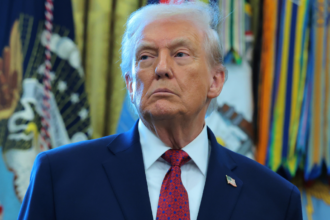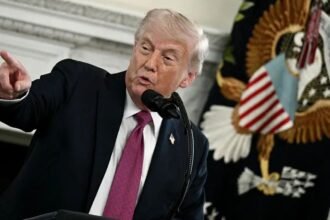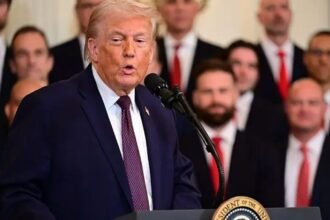

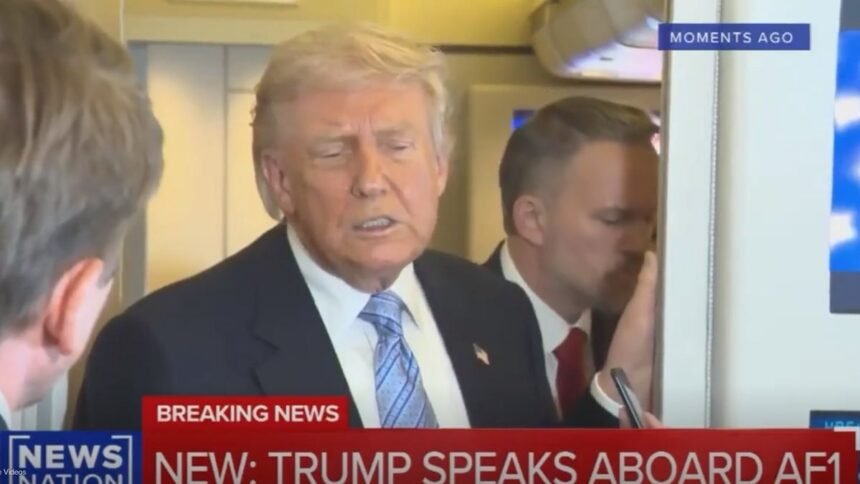
A confused President Donald Trump made a bizarre mix-up during a war question aboard Air Force One on Friday, briefly appearing to confuse Taiwan with Iran in front of a group of reporters. The exchange was rambling, disjointed, and hard to follow. Critics wasted no time calling it one of the most alarming moments of his second term.
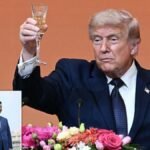
Trump was flying home to the United States after completing his state visit to China, where he had held high-stakes meetings with Chinese President Xi Jinping at the Great Hall of the People in Beijing. The two leaders covered a wide range of sensitive topics during those talks, including Taiwan, trade tensions, and the ongoing American military intervention in Iran. It was Trump’s first visit to Beijing since 2017, and the stakes could not have been higher.
Before Trump even boarded his flight home, Xi had already delivered a stark and direct warning. Beijing’s official readout of the summit stated clearly that Xi told Trump that mishandling the Taiwan issue could push the two countries toward open confrontation. That warning made what happened next on Air Force One all the more shocking to watch.
A reporter asked Trump to respond to Xi’s public statement that there was a genuine risk of conflict with the United States over Taiwan. The question was direct, serious, and required a clear answer from the leader of the free world. Instead, Trump gave one that left everyone in the room confused.
“I don’t think there’s a conflict other than we don’t need their strait,” Trump said.
The remark instantly raised red flags. Taiwan is separated from mainland China by the Taiwan Strait, a body of water that has been at the center of decades of geopolitical tension between Washington and Beijing. The Strait of Hormuz, on the other hand, is the critical oil shipping route that has been effectively shut down amid America’s ongoing military campaign in Iran. These are two entirely different waterways, in two different parts of the world, connected to two completely separate crises.
Social media erupted within minutes of the clip spreading online. Viewers and political commentators across the spectrum immediately pointed out that Trump appeared to have mentally drifted away from Taiwan and into Iran territory. Many said it was not just a slip of the tongue but a clear sign that the 79-year-old president could not keep his own foreign policy crises straight.
The reporter in the room noticed the confusion right away and tried to bring Trump back to the original question. She interrupted him calmly but firmly, attempting to redirect the conversation where it needed to go.
“But on Taiwan,” the reporter said, cutting in to steer things back on track.
What followed did very little to reassure anyone who was watching. Trump began shifting back and forth between Taiwan and Iran in the same answer, blending two separate and deeply consequential international situations into one tangled response.
“No, no, I don’t think so. I think we’re going to be, I think we’ll be fine,” Trump said. “[Xi] doesn’t want to see a war. I mean, we have two things, the Iranian situation and on Taiwan, he doesn’t want to see a movement of independence.”
Trump then repeated what he claimed Xi had told him privately about Taiwan’s future during their closed-door meeting in Beijing. He quoted the Chinese president as making a bold and sweeping claim about historical ownership of the island.
“He said, look, we’ve had it for thousands of years, a certain period of time, and then left, and we’re going to get it back,” Trump said.
The president told reporters he made no commitment either way on Taiwan during his conversations with Xi. That alone alarmed lawmakers on both sides of the aisle who had been pushing for a clear and strong American position on the island’s defense.
Then came the moment that made the entire exchange so much worse.
When a reporter pressed Trump directly on whether the United States would militarily defend Taiwan if China launched an invasion, he refused to give a straight answer. Rather than offering the kind of firm, clear deterrence that American allies in the region rely on, Trump turned the question into a display of personal secrecy.
“There’s only one person that knows that, you know who it is? Me, I’m the only person,” Trump said aboard Air Force One.
He then revealed, almost casually, that Xi Jinping had asked him the exact same question during their private summit in Beijing just hours earlier.
“That question was asked to me today by President Xi,” Trump said. “I said I don’t talk about that.”
The refusal to answer was alarming enough on its own. But coming right after the Taiwan-Iran mix-up, it painted a deeply troubling picture of a president who struggled to maintain basic clarity on the most consequential foreign policy questions facing the nation.
This is far from the first time Trump’s mental and physical fitness has sparked serious public debate. Since returning to the White House for his second term, he has repeatedly shown signs of cognitive slippage that critics say are nearly identical to the issues he once used to attack his predecessor, Joe Biden. The irony has not been lost on anyone paying attention.
Reports have captured Trump dozing off during Oval Office and Cabinet meetings on multiple occasions. He has been seen drifting off mid-sentence during public appearances and press events. Photographs have repeatedly shown persistent bruising on his right hand and visibly swollen ankles that have fueled ongoing questions about his overall health behind closed doors.
More than 30 senior doctors have now signed a public statement declaring Trump mentally unfit for office. Polls show that confidence in his mental sharpness has dropped sharply among Americans, including among his own supporters. By May 2026, a majority of Americans said they did not believe Trump was mentally fit to serve as president.
Friday’s Air Force One exchange did nothing to quiet those concerns. If anything, it made them louder. And for a president who once built his entire brand on strength, clarity, and toughness, the moment he fumbled a basic war question in front of the whole world may be the one that history remembers most.