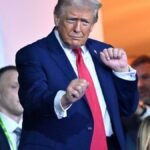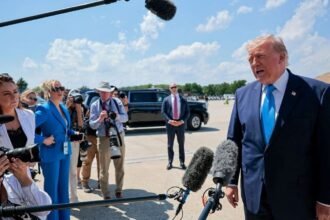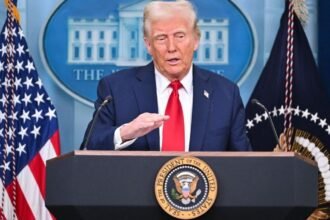

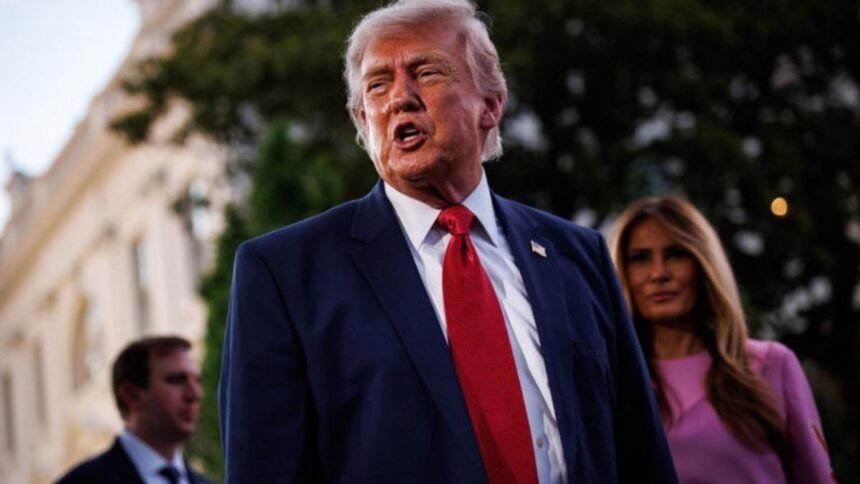
President Donald Trump’s slurred words at a Coast Guard commencement ceremony on Wednesday, May 20, left the crowd visibly stunned and sent dementia rumors spreading wildly across social media. The moment, captured on video, showed Trump struggling through basic speech in front of graduating cadets in New London, Connecticut. The crowd’s shocking reaction rippled far beyond the venue, and the White House was left almost speechless in its effort to explain what millions had already seen and heard.
Trump, who turns 80 next month, opened his remarks by assuring the graduating Coast Guard cadets that America’s “national slengtheses back,” a mangled attempt at saying “national strength is back.” The slurred phrase instantly went viral, with journalists, political commentators, and everyday viewers sharing the clip across every major platform. It quickly became one of the most-watched moments of his presidency in recent months.
The speech took place under brutal 90-degree heat, with nine people hospitalized for heat-related illness during the 53-minute address. Trump stood at the podium for nearly an hour, delivering remarks that wandered far from the spirit of a graduation ceremony. The conditions made for an uncomfortable setting, though the slurring was what captured the most attention.
Trump is slurring heavily: "Our national strennngsssss is back" pic.twitter.com/saRkA2m1Pp
— Aaron Rupar (@atrupar) May 20, 2026At times, the speech carried genuinely motivational notes aimed at the new graduates. “Never stop pushing forward,” Trump told the cadets. “No matter how terrible the storm, no matter how difficult the mission. Never surrender, keep going, keep fighting, and make the adversary quit first.” The words were strong on paper, but the delivery told a different story.
He also offered a pointed warning to the graduates about challenges ahead. “You’ve all been tested,” Trump said. “You’ll be tested further and probably at higher levels as your career goes on.” The cadets listened politely, though the energy in the room never quite rose to meet the occasion.
The speech did not hold its focus for very long. In a pattern that has become almost routine, Trump steered the ceremony away from its purpose and toward political grievances that had nothing to do with the graduating class. A commencement address for the nation’s newest Coast Guard officers quickly became a political platform.
“Some lunatics would like to take this country way, way left and destroy it,” Trump declared before the assembled graduates and their families. “But we are not going to let that happen. We are not letting that happen.” The comment drew a muted response from an audience that had come to celebrate a milestone, not attend a campaign rally.
Trump also made an unexpected detour into immigration policy during the address. “They can come in, but they have to come in legally,” he said. “They have to come in through a process. They have to love our country, not that they want to blow up our country.” It was a familiar talking point delivered in an entirely unfamiliar setting.
This was far from the first time Trump’s speech has set off widespread concern. Back in February, he visibly struggled to say the word “undisputed” while accepting the inaugural “Undisputed Champion of Beautiful Clean Coal” award from the Washington Coal Club. That moment, too, circulated widely and became fodder for late-night television commentary.
Donald Trump accepted the inaugural Undisputed Champion of Beautiful Clean Coal award with grace, incoherence, and a condescending dig at coal miners pic.twitter.com/UmlwdFVECY
— The Daily Show (@TheDailyShow) February 13, 2026The slurring is only one piece of a larger picture that has worried many Americans. Trump has also been seen appearing to fall asleep during official White House events on multiple occasions this year. He has regularly mixed up country names during public remarks, and has been photographed with bruised hands and noticeably swollen ankles. Each incident on its own might be dismissed, but together they form a pattern that is increasingly hard to ignore.
Public concern is now reflected in hard polling numbers. A Washington Post/ABC News/Ipsos poll found that 59 percent of Americans doubt Trump’s mental acuity and 55 percent question his physical health. A separate YouGov survey found that 48 percent of Americans believe Trump is suffering some degree of cognitive decline. The share of independents expressing concern has risen sharply since he began his second term.
The White House, as usual, did not engage with the substance of those concerns. In a statement to The Daily Beast, a spokesperson responded by saying, “President Trump’s sharpness, unmatched energy, and historic accessibility stand in stark contrast to what we saw during the last administration.” That kind of answer has become almost as predictable as the incidents that trigger it.
Trump has also long boasted about passing cognitive screening tests, though he consistently misrepresents what those tests actually measure. He has repeatedly called the Montreal Cognitive Assessment an “I.Q. test,” when it is actually a basic screening tool used to detect early signs of dementia. The exam includes tasks like drawing a clock face and identifying a picture of a squirrel, not exactly the kind of material that proves superior intellect.
What happened at the Coast Guard graduation on Wednesday is part of a story that keeps writing itself. The videos keep coming, the denials keep following, and the gap between what the public sees and what the White House says keeps growing wider. As Trump inches closer to 80, that gap may soon become impossible to paper over with a press statement.