
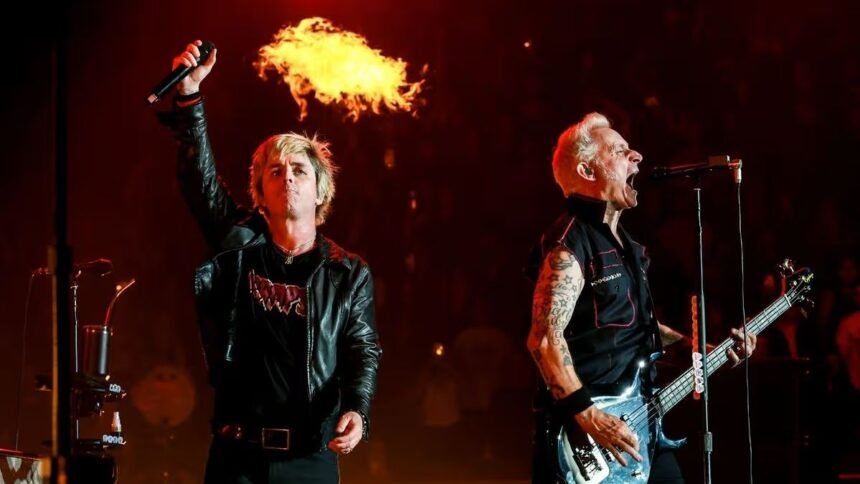
Green Day is heading into Super Bowl Sunday doing what the band has done for decades: using a huge stage to say something pointed about American politics. Ahead of their scheduled performance at the Super Bowl LX opening ceremony at Levi’s Stadium in Santa Clara, California, the trio updated the lyrics to two of their best-known songs during a San Francisco warm-up show, turning familiar choruses into unmistakable political signals.
At Spotify and FanDuel’s invite-only party at Pier 29 on February 6, Billie Joe Armstrong swapped a key line in “American Idiot” from “I’m not a part of a redneck agenda” to “I’m not part of a MAGA agenda.”
The change is small on paper, but it is designed for instant recognition in a country where politics now travels through slogans as much as through policy.

A Very Specific Lyric Swap
The “MAGA agenda” rewrite matters because “American Idiot” has always been a protest song about media, fear, and political manipulation, but the updated line makes the target explicit. It also fits a pattern: Armstrong has been using this change in live performances recently, and the Pier 29 show confirmed he is carrying it into Super Bowl weekend.
This is not just a stunt for attention. In the current U.S. media environment, a single line delivered on a major broadcast can travel further than a full interview. It is also consistent with Green Day’s modern legacy: a band that built its biggest political era around American Idiot was never likely to show up to America’s biggest sports event and pretend politics does not exist.
“Holiday,” Jeffrey Epstein, and a Single Sentence
Armstrong also changed a line in “Holiday,” a song that already reads like a critique of war politics and public spin. In the interlude, he replaced “The representative from California has the floor” with “The representative from Epstein Island has the floor,” a reference that gestures at elite impunity and the lasting public outrage around Jeffrey Epstein.
Front Office Sports also reported the lyric change and framed it as part of Green Day’s broader political commentary during Super Bowl week, raising the obvious question: will the band repeat it on the Super Bowl stage, where the audience is bigger and the reaction is instant?
The point here is not that Green Day is delivering a legal argument in song form. The point is that the band is using cultural shorthand to describe a feeling many Americans recognize: that powerful people too often avoid consequences, and that public life can be arranged to protect insiders.
The ICE Comments and the Minneapolis Dedication
At the Pier 29 event, Armstrong also addressed U.S. Immigration and Customs Enforcement (ICE) directly, telling ICE agents to “quit” and warning they would eventually be discarded by the politicians they serve. The language is blunt, but the message is clear: the band is tying politics to real-world enforcement and its costs.
Coverage of the same show noted that Armstrong dedicated “Holiday” to Minneapolis, linking the moment to the broader national debate over immigration enforcement and protest politics.
To keep this accurate and responsible, it’s important to separate verified reporting from looser claims circulating in parts of the media ecosystem. What is clearly supported by the sourced reporting here is the lyric changes and Armstrong’s ICE remarks at the San Francisco event.

Why This Lands on Super Bowl Sunday
The Super Bowl is not just a football championship. It is one of the few remaining events where Americans with very different politics watch the same thing at the same time. That is why even a few seconds of music can turn into a national argument.
Green Day will perform during the opening ceremony, and the halftime show will feature Bad Bunny, whose own political statements have also drawn attention during Super Bowl week.
What makes Green Day’s move especially effective is how simple it is. They did not rewrite whole songs. They changed a few words in songs millions of people already know. That is the strategy: use a familiar hook, insert a new target, and let the audience fill in the meaning.
What to Watch For Next
If Green Day repeats these lines during the Super Bowl LX broadcast, the reaction will be loud, fast, and predictable. Supporters will call it brave. Critics will call it inappropriate. That’s the modern media machine: the argument becomes part of the event.
But there is a more useful way to read the moment. Green Day is betting that the country is ready to hear its most famous protest songs updated for a new political era. And the NFL, by booking openly political artists, is betting that controversy does not shrink the audience. It often expands it.