

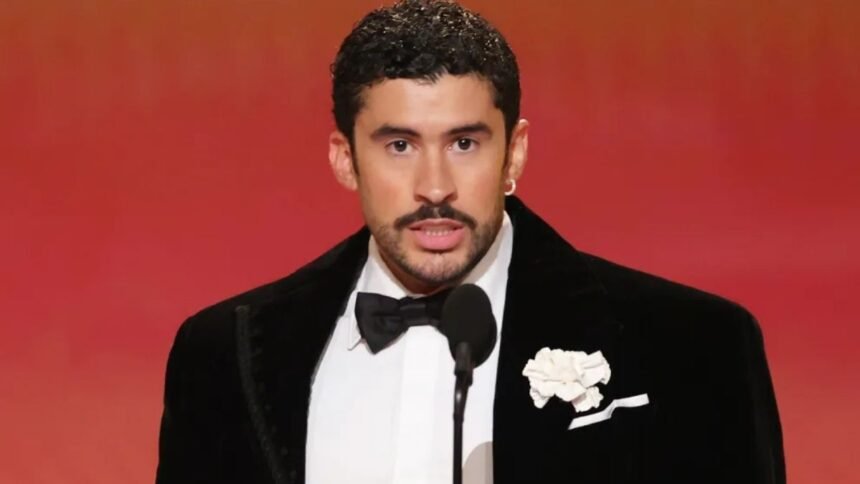
Bad Bunny just broke every record that mattered. When the Puerto Rican superstar took the stage at Super Bowl LX on February 8 at Levi’s Stadium in Santa Clara, California, nobody needed convincing that it was going to be a massive performance.
What nobody fully anticipated was the scale of what came after — 4.157 billion views in the first 24 hours across global and U.S. broadcasts, YouTube, and other digital platforms, making his halftime show the single most-watched Super Bowl halftime performance of all time.
The record is now official, confirmed by Roc Nation, the halftime show’s co-producer, in an announcement made Monday.
The Numbers Don’t Lie
To understand just how significant 4.157 billion views in 24 hours actually is, it helps to put it in plain terms. That number is roughly half the population of the entire planet. It is a figure that no previous halftime show performer — not Beyoncé, not Kendrick Lamar, not Shakira and Jennifer Lopez — had ever come close to generating in a single day. The combined viewership came from global and U.S. television broadcasts, YouTube, and every other major digital property where the performance was made available.
It is worth noting that at press time, Roc Nation had not broken down the exact figures by platform, and there was no independent third-party verification of the total number. The official U.S. television audience for the halftime show was separately reported at 128.2 million viewers — a figure that was slightly down from last year’s total of 133.5 million. The gap between those two numbers tells its own story. The 4.157 billion figure is driven almost entirely by Bad Bunny’s extraordinary global reach, particularly across Latin America, Europe, and Asia, where his fanbase dwarfs that of almost any English-language artist currently working.
Why Bad Bunny Was Always Going to Win
The record-breaking viewership is not actually surprising when you look at who Bad Bunny, born Benito Antonio Martínez Ocasio, actually is in the global music landscape. He was Spotify’s most-streamed artist in 2025, a title he also held in 2020, 2021, and 2022. No other artist in the history of that platform has dominated streaming at that level across that many years. He performs entirely in Spanish. He has never made a significant commercial concession to English-language radio. And yet he fills stadiums on every continent and breaks every chart that exists.
His Super Bowl selection had been controversial in some corners. Republicans called for investigations into his show, calling the performance politically charged. Petitions circulated demanding he be replaced. None of it mattered. When the lights came on and the music started, 4.157 billion people — in every country, in every time zone — found a way to watch. That is what a truly global artist looks like.
The Charts Are Still Moving
The Super Bowl performance is not just a historical footnote. It is still actively reshaping the music charts weeks later. Bad Bunny’s album DeBÍ TiRAR MáS FOToS notched its fifth week at the top of the Billboard Global 200 chart this week, after first leading for two weeks back in January and February 2025. At the same time it held its third consecutive week at No. 1 on the Billboard Global Excl. U.S. chart — a position it has held continuously since his February 7 performance.
The album also returned to No. 1 on the Billboard 200 for a fifth nonconsecutive week on the February 28-dated chart. That followed two weeks in the runner-up slot after the Super Bowl set and his win for Album of the Year at the 2026 Grammy Awards — the first Spanish-language album to win the award in Grammy history.
What This Moment Actually Means
The Super Bowl halftime show has always been the biggest stage in American entertainment. But what Bad Bunny just demonstrated is that the biggest stage in American entertainment is no longer only American. It belongs to the world now. A Puerto Rican artist performing entirely in Spanish just out-watched every English-language performance that has ever appeared at that event. That is a cultural shift, not just a chart milestone.
The people who tried to stop him from being on that stage did not understand what they were looking at. The 4.157 billion people who watched did.