
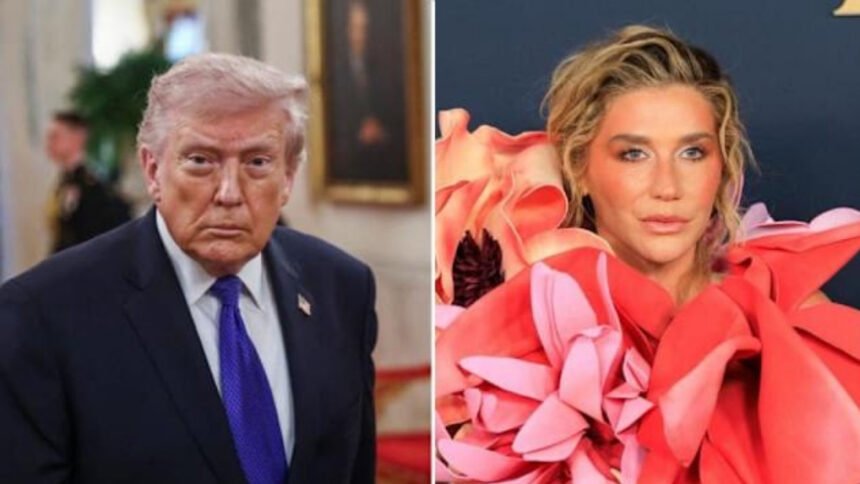
Pop star Kesha drew a line in the sand this week — and the Trump White House crossed it. After the administration used her song without permission to hype a military strike on Iran, Kesha fired back with four words that stopped the internet cold: “Stop using my music, perverts.” That phrase, directed straight at the official White House account, was not just a celebrity complaint. It was a cultural flashpoint — a moment where music, politics, and war collided in real time, and one pop star refused to stay quiet.
It began on February 10, when the White House posted a TikTok video titled “Lethality” — a slick clip showing a fighter jet launching a missile and destroying what appeared to be an enemy ship. Playing underneath that footage, without any permission, was Kesha’s 2010 hit “Blow.” The video racked up over 15 million views. Nobody from the administration asked Kesha. Nobody warned her. The White House simply took her music and used it to promote war.
When Kesha found out, she did not stay silent. She took to social media and wrote: “Trying to make light of war is disgusting and inhumane. I absolutely do not approve of my music being used to promote violence of any kind. Love always trumps hate. This show of blatant disregard for human life is the opposite of everything I stand for.”
It was a powerful statement — but the White House was not done.
The White House Fires Back
Steven Cheung, the White House Director of Communications, responded to Kesha’s objection with open mockery. “All these singers keep falling for this,” Cheung posted on X. “This just gives us more attention and more view counts to our videos because people want to see what they’re bitching about. Thank you for your attention to this matter.”
It was a classic Trump-era move — dismiss, demean, and claim victory. The idea was simple: every artist who complains is just doing free advertising for the administration. Cheung seemed confident that the White House had won the round.
He was wrong.
Kesha Wins the Internet
Kesha’s response to Cheung’s mockery was short, sharp, and completely unforgettable. She posted just five words directly at the official White House account: “Stop using my music, perverts.”
The numbers told the full story. Cheung’s mocking post received just over 26,000 views on X. Kesha’s five-word reply? Almost 547,000 views — more than twenty times the reach. Her original objection post surpassed one million views. So much for giving the White House free attention.
A Pattern Nobody Can Ignore
What makes this story bigger than one pop star’s objection is what it reveals about a pattern. The Trump administration has spent years using music without permission, and artists have spent years fighting back — with varying degrees of success.
Just weeks before Kesha’s clash, the estate of Isaac Hayes reached a financial settlement with Trump after the administration used the Hayes-co-written classic “Hold On, I’m Coming” at campaign rallies. The estate made clear the payout “reaffirms the importance of protecting intellectual property rights, especially as they relate to legacy, ownership, and the responsible use of creative works.”
Days later, British rock band Radiohead responded to Immigration and Customs Enforcement using their song “Let Down” in a promotional video shared across Trump, White House, and DHS accounts. “We demand that the amateurs in control of the ICE social media account take it down,” the band said. “It ain’t funny, this song means a lot to us — and you don’t get to appropriate it without a fight.” They ended their statement with two words that cannot be printed here, but that every reader can imagine.
Kesha, in her own way, said exactly the same thing.
Why This Moment Matters
The Iran war has already divided the country, split Trump’s own MAGA base, and drawn criticism from voices as different as Tucker Carlson and Marjorie Taylor Greene. But the Kesha moment cuts through the noise in a way that policy arguments rarely do — because music is personal. When the government takes a song you love and puts it under footage of missiles and war, it feels like a violation. When the pop star who made that song tells the White House they are perverts for doing it, millions of people feel seen.
The administration wanted a TikTok moment. What they got instead was a reminder that artists have audiences too — and those audiences are paying attention.
As Kesha herself once wrote in a very different context: the party does not stop. But this time, the party she is shutting down belongs to the White House.