
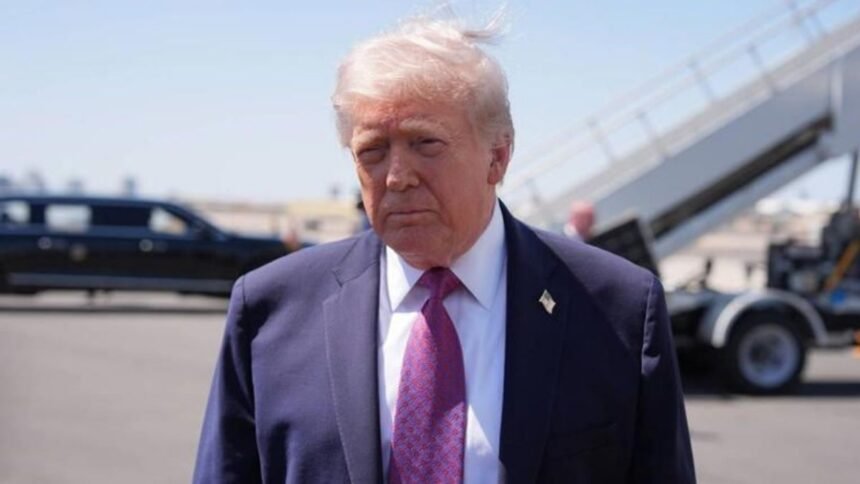
What happened on the plane ride home from China was supposed to stay quiet. But leaked details have now revealed just how panicked Donald Trump’s team truly was in those final moments on the tarmac, rushing to make sure nobody would bring a single Chinese-issued item on board. Staff threw every gift, every pin, and every credential into a dustbin sitting at the bottom of the Air Force One stairs, and one reporter who witnessed it all said it plainly: “This is embarrassing.”
But to understand why the departure felt so charged, you have to go back to how the trip began. Xi Jinping, 72, rolled out the full imperial treatment for the American president, with grand processions, ornate halls, and perfectly positioned officials at every corner. It was the kind of spectacle designed to make one leader look timeless and the other look like a visiting guest who did not quite belong.
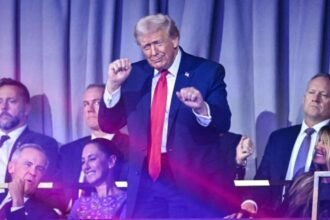
Trump, 79, kept his well-known temper under control throughout most of the visit. Critics online accused China of outmaneuvering him at every turn, turning the former reality television star into a prop inside Xi’s carefully staged spectacle. For the most part, he played along, and the world was watching every second of it.
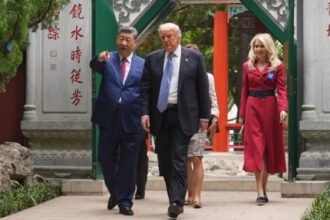
Trump and Xi stopped mid-stride outside the Great Hall of the People when translators and aides suddenly swarmed them. In one widely circulated moment, the U.S. president could be seen navigating the Hall’s vast ceremonial corridors, flanked by Chinese officials and nearly swallowed by the scale of the architecture. The precision of the procession made it look less like a diplomatic meeting and more like a performance where only one side knew the script.
The press and photographers flanked Trump almost constantly during the entire trip. Usually he commands the press with ease, but that is in America and not in China. On Chinese soil, the rules of engagement were entirely different, and it showed in almost every public moment he had.
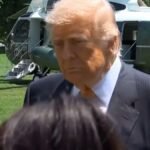
When reporters asked how the meetings went, he simply said, “Great.” When pressed specifically about Taiwan, where Xi had reportedly warned that interference could lead to “clashes and even conflicts” between the two nations, something visibly shifted. The question hung in the air, and the room got noticeably uncomfortable very fast.
“Great place. Incredible. China’s beautiful,” Trump blurted out, while Xi stood beside him, smiling with the serenity of a man who had absolutely prepared for that exact moment. Reporters pressed further, asking follow-up questions that demanded real answers. The president went silent, stared ahead for several long seconds, then turned and simply walked away.
One moment that had social media buzzing came from inside one of the ornate reception rooms at Zhongnanhai Garden. Armchair analysts online became convinced China made Trump’s seat slightly lower than Xi’s, orchestrating a subtle power play. People compared pillow heights and posture angles, laughing at what they believed was a deliberate move to make the American president look subordinate on the world stage.
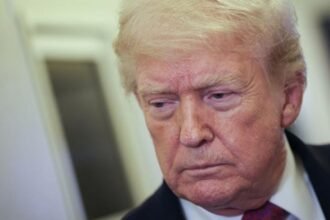
For the sake of the trip, Trump appeared to say the right words and looked diplomatic when it mattered most. But by the time Air Force One lifted off on Friday to return to the United States, the footage told a very different story. The carefully maintained mask had slipped, and the tension that had been building all week was suddenly impossible to ignore.
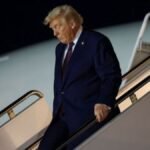
The breaking point came right on the tarmac at Beijing Capital International Airport. As Trump walked toward his jet, a Chinese cameraman apparently decided the designated press area was more of a suggestion than an actual rule and edged forward for a closer shot. Secret Service agents were on him within seconds, with one stepping directly in front of the man, issuing a firm warning, and physically pushing him away when he failed to comply fast enough.
Agent notices suspicious Chinese “photographer” and quickly rushes him away seconds before Trump reaches Air Force One pic.twitter.com/ATJPoag8n4
— Matt Wallace (@MattWallace888) May 15, 2026The clip exploded across social media almost immediately. “China is so advanced they might have cameras for guns,” one person wrote. Another posted, “Unfortunately the cameraman had plenty of time to do damage before security even moved.”
A third comment offered dryly, “Trump is more suspicious than the cameraman.” “Air Force One security probably assumes every camera bag contains either lenses or a congressional hearing,” came another remark that quickly spread across platforms.
Someone else wrote, “These airport moments involve multiple security layers. Anything outside protocol gets intercepted quickly before leaders pass through.” One commenter added, less diplomatically, “He shouldn’t have been there. It could have gone completely sideways.”
But the cameraman incident was only one piece of a much larger story quietly unfolding behind the scenes. Behind the glittering ceremonies and carefully managed photo opportunities, the deep distrust between the two delegations had reportedly never let up for a single moment during the entire visit.
The jaw-dropping security details were first exposed by New York Post White House correspondent Emily Goodin, who traveled with the presidential press pool. According to Goodin, U.S. officials treated every single item handed out by Chinese authorities as a potential national security threat. Credentials, delegation pins, and even burner phones were all confiscated before anyone was permitted to board Air Force One.
Everything collected from the Chinese side was dropped into a single bin sitting at the bottom of the aircraft stairs. The image of staffers tossing official Chinese-issued items into a garbage bin on the tarmac said more about the state of U.S.-China trust than any diplomatic statement issued during the entire trip.
“American staff took everything Chinese officials handed out — credentials, burner phones from WH staff, pins for delegation — collected them before we got on AF1 and threw them in a bin at the bottom of the stairs,” Goodin wrote. “Nothing from China allowed on the plane. We’re taking off shortly for America.”
Fox News host Ainsley Earhardt separately confirmed the account on air. She said sources on the plane told her that all Americans had been using burner phones throughout the entire China trip and were required to destroy and leave them behind before departure. “They don’t want anything that belongs to the Chinese left on that plane because they could be bugged,” Earhardt said on Fox and Friends.
This level of concern is not without serious historical precedent. China’s intelligence apparatus, including state-sponsored hacking groups like Salt Typhoon, has long been accused of embedding surveillance tools inside everyday objects given to foreign visitors. The U.S. government has repeatedly warned that foreign-issued devices can be used to silently collect sensitive data on American officials traveling abroad.
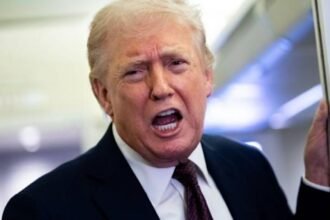
Even Trump himself openly acknowledged the reality on the flight home. Speaking to reporters on Air Force One, he admitted plainly, “It’s one of those things because we spy like hell on them too.” It was a rare moment of unscripted honesty that landed somewhere between diplomatic candor and a diplomatic problem.
Trump came to Beijing to project strength, and the cameras were rolling for every handshake and every grand entrance. But by the time the plane door closed and that bin full of discarded Chinese gifts was left behind on the tarmac, the carefully constructed image of goodwill had already started to fall apart. Every gift, every pin, and every phone issued by the Chinese side went straight into the dustbin, and judging by how fast the details leaked, Trump’s team was not even close to prepared for the world to notice.